World Chess Championship 2026: Gukesh and Sindarov Set for Historic Battle Between Two 20-Year-Olds
- Indian world champion Gukesh Dommaraju will face Uzbekistan’s Javokhir Sindarov in the youngest-ever World Chess Championship contest.
- The 14-game championship in Geneva offers a $2.5 million prize fund and could continue until December 12.
- Sindarov enters the competition ranked fourth in the world, while defending champion Gukesh has slipped to 26th.
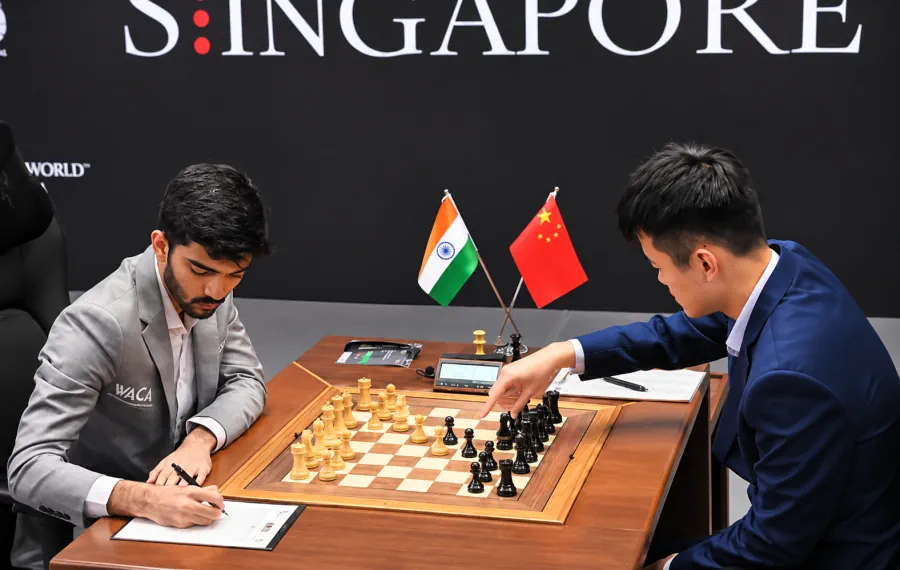
Two of the world’s youngest chess grandmasters are preparing for a historic showdown as India’s defending champion Gukesh Dommaraju takes on Uzbekistan’s Javokhir Sindarov in the World Chess Championship 2026, beginning Tuesday in Geneva, Switzerland.
Both players are just 20 years old, making their encounter the youngest-ever contest for the world chess title. The championship will be decided through a best-of-14-game format, with the competition potentially continuing until December 12.
Also Read:
Gukesh, who made history in 2024 by becoming the youngest undisputed world chess champion at the age of 18, is determined to secure another victory rather than simply protect his existing title.
Speaking ahead of the championship, the Indian grandmaster said he was approaching the competition with the intention of winning the world title again. He described Sindarov as one of the strongest players currently competing at the highest level and acknowledged that the match would be a major test of his abilities.
Gukesh also expressed excitement about competing against such a talented opponent, saying the championship would provide an opportunity to discover how well he could perform under pressure.
His challenger, Sindarov, is five months older than Gukesh. Both players demonstrated exceptional talent from an early age and achieved the prestigious grandmaster title when they were only 12 years old.
Despite entering the championship in excellent form and holding a significantly higher world ranking than Gukesh, Sindarov has described the contest as evenly balanced, estimating that both players have a 50 percent chance of winning.
The Uzbek grandmaster explained that he had participated in numerous competitive matches over the previous six months to improve his preparation. However, he acknowledged that even this extensive experience might not be enough for a championship of such difficulty.
Under the tournament rules, each victory earns a player one point, while a draw gives both competitors half a point. The first player to accumulate 7.5 points will be declared world champion.
If the championship finishes level at 7-7 after 14 games, additional tie-break games will determine the winner.
Individual games can last several hours, requiring both players to demonstrate exceptional concentration, strategic planning and physical endurance throughout the competition.
The championship carries a total prize fund of $2.5 million. Each player will receive $200,000 for every game won, while the remaining prize money will be divided equally between the competitors.
Gukesh earned his place in chess history during the 2024 World Chess Championship in Singapore, where he defeated China’s Ding Liren to claim the title at just 18 years old.
Sindarov secured the right to challenge the Indian champion after winning the eight-player Candidates Tournament held in Cyprus in April.
The two competitors enter the championship with contrasting recent performances. Sindarov has climbed to fourth position in the global chess rankings following a series of impressive results, while Gukesh has fallen to 26th.
Norwegian grandmaster Magnus Carlsen continues to occupy the top position in the world rankings.
The championship officially opened on Sunday with a ceremony at the United Nations Assembly Hall in Geneva, where organisers introduced a distinctive Swiss chocolate-themed method to determine which player would make the opening move.
Two Swiss clocks containing oversized chocolate chess knights, one white and the other dark, were presented on stage.
Gukesh selected one of the clocks and discovered the dark chocolate knight inside. As a result, Sindarov will play with the white pieces in the opening game, giving him the advantage of making the first move.
The championship will take place at the Fondation Martin Bodmer, a renowned museum and library overlooking Lake Geneva.
The historic institution houses an extensive collection of manuscripts, rare books, first editions and archaeological artefacts documenting the development of human thought and literature.
Both grandmasters visited the venue on Saturday to familiarise themselves with the playing conditions before the competition.
Gukesh revealed that he had carefully examined several details, including the chairs, lighting and flooring, to ensure that nothing would distract him during the lengthy games.
The Indian champion has spent recent months concentrating specifically on preparations for his title defence, while Sindarov has continued participating in competitive tournaments.
Gukesh explained that one of the advantages of a World Chess Championship match is the opportunity to focus entirely on a single opponent rather than preparing for several different players.
He said this allows for detailed examination of an opponent’s playing style, strengths, weaknesses and preferred strategies.
Sindarov, meanwhile, praised Gukesh for his determination and ability to continue fighting even in difficult positions.
The Uzbek challenger highlighted the Indian champion’s strong calculation skills and his understanding of particular chess positions, describing these qualities as important strengths.
Beyond the competition itself, International Chess Federation (FIDE) president Timur Turlov expressed optimism about the growing worldwide popularity of chess.
He said the sport was experiencing significant growth and was moving closer to becoming a commercially successful global sporting competition.
Turlov identified digital chess platforms and artificial intelligence as two important factors behind the game’s expanding popularity.
According to him, the increasing availability of online chess and AI-powered coaching tools is making high-quality training more accessible to aspiring players worldwide.
He believes these technological developments will help introduce more people to chess, improve training opportunities and support the emergence of future generations of international chess stars.