Supreme Court Rules Private Land With Graves or Shrines Does Not Automatically Become Auqaf Property
- Supreme Court rules that the presence of a grave or shrine on private land does not automatically establish it as Waqf property.
- The court declares the Punjab Auqaf Department’s 2003 notification illegal and dismisses its appeal.
- Auqaf Department directed to return 5 kanals and 3 marlas of land, along with its buildings, to the original owner within 30 days.
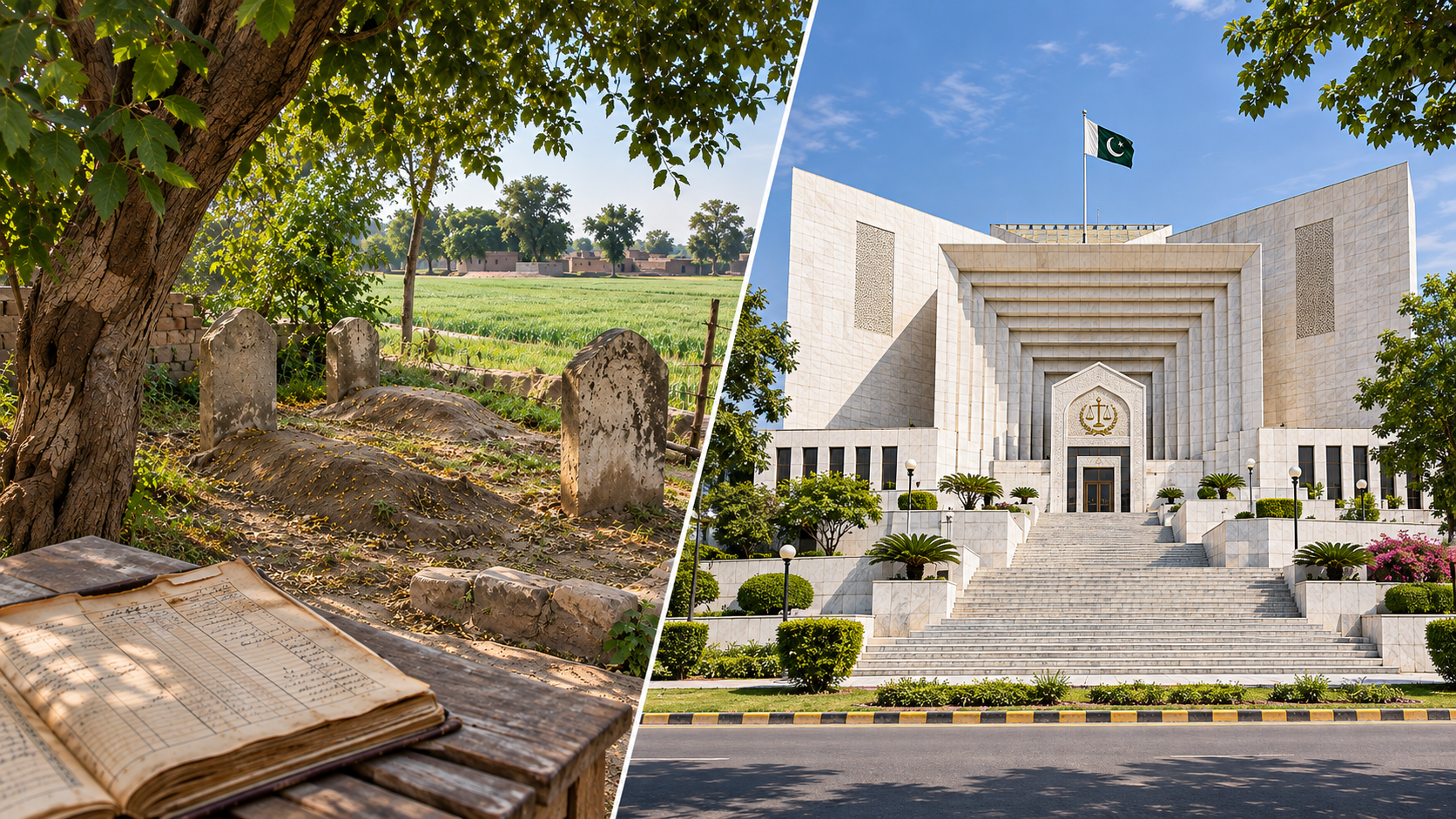
The Supreme Court of Pakistan has ruled that privately owned land cannot automatically be declared the property of the Auqaf Department simply because a grave or shrine exists on it, devotees visit the site or religious offerings are collected there.
The apex court dismissed an appeal filed by the Chief Administrator Auqaf Punjab and declared the department’s decision to assume management and possession of the private property unlawful.
Also Read:
In a 10-page written judgment authored by Justice Shahid Waheed, the Supreme Court clarified that permanent religious endowment, commonly known as Waqf, must be established through evidence before any property can be declared Waqf land.
The judgment stated that if a person constructs a grave for a loved one on privately owned land, the act alone does not change the legal status or ownership of the property.
Similarly, the establishment of a shrine on private land, visits by devotees and the collection of religious offerings cannot be treated as sufficient evidence that the property has been permanently dedicated as Waqf.
The Supreme Court further observed that the Auqaf Department has no authority to assume possession or management of privately owned property without the consent of its owner. The department also cannot take control of the property without obtaining the consent of a living Waqif, the person who dedicates property as a religious endowment.
The judgment placed the responsibility of proving permanent endowment on the party claiming that a particular property is Waqf. The court also clarified that the mere mention of a shrine or Darbar in official revenue records does not establish the Auqaf Department’s ownership of the land.
Examining the legality of the department’s takeover, the Supreme Court found that mandatory legal requirements had not been fulfilled and the required notice had not been served. Consequently, the notification authorising the department to assume management of the property had no legal validity.
The apex court declared the Auqaf Department’s notification issued on November 19, 2003, illegal and beyond its jurisdiction. It also upheld the earlier decision of the Lahore High Court while providing further legal reasoning regarding the ownership and management of Waqf properties.
The Supreme Court directed the Auqaf Department to restore the management, control and possession of the disputed 5 kanals and 3 marlas of land, including all buildings constructed on the property, to its original owner within 30 days.
The court also instructed the relevant revenue authorities to correct the land records and rectify the mutations made on the basis of the invalid Auqaf Department notification.