Pakistani Rupee Strengthens Against US Dollar, Closes at Rs276.50 in Interbank Market
- The Pakistani rupee gained one paisa against the US dollar on Monday, November 23, closing at Rs276.50 in the interbank market.
- The US dollar was quoted at Rs277.27 for buying and Rs278.47 for selling in the open market.
- Global currency markets remained cautious ahead of the US Federal Reserve’s December policy meeting, while international oil prices declined.
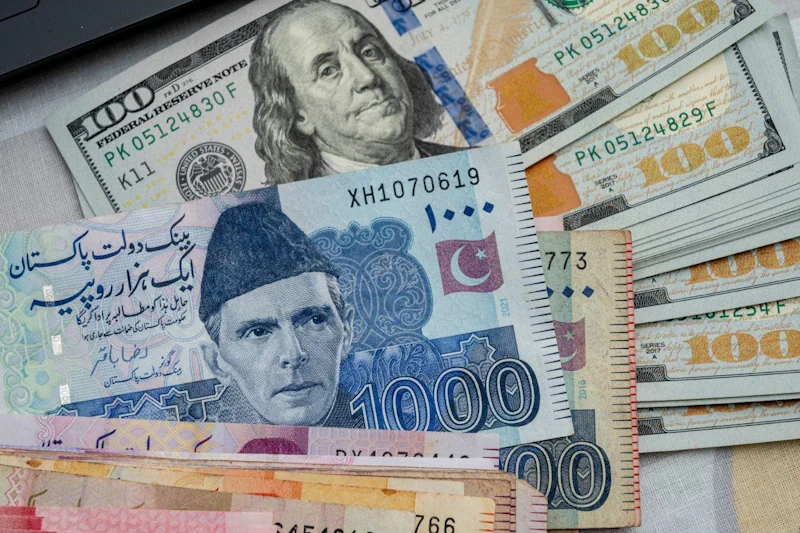
The Pakistani rupee maintained its gradual recovery against the US dollar on Monday, November 23, 2026, recording another marginal improvement in the interbank market as international currency markets responded to changing expectations surrounding US interest rates.
According to the latest reported closing figures, the local currency appreciated by one paisa against the American dollar, finishing at Rs276.50 compared with Rs276.51 at the previous close.
Also Read:
The improvement continued the rupee’s recent pattern of small gains against the greenback. During the preceding week, the Pakistani currency strengthened by approximately 0.03 percent in the interbank market, indicating relatively stable trading conditions.
The interbank market quoted the US dollar at Rs276.50 on the buying side and Rs276.70 on the selling side on Monday.
The rupee also recorded mixed movements against major foreign currencies in the open market, including the euro, UAE dirham and Saudi riyal.
Official exchange-rate figures for November 23 confirm the rupee’s closing level and provide updated rates for other major currencies.
In the open market, the US dollar closed at Rs277.27 for buying and Rs278.47 for selling. The rupee gained one paisa on the buying side but weakened by seven paise on the selling side compared with the previous session.
Against the euro, the rupee declined by one paisa on the buying side but strengthened by nine paise on the selling side, with the European currency quoted at Rs304.33 and Rs307.23, respectively.
The UAE dirham was quoted at Rs75.57 for buying and Rs76.14 for selling, reflecting a two-paisa improvement in the rupee on both sides. The Saudi riyal remained unchanged at Rs73.99 for buying and Rs74.49 for selling.
The British pound was quoted at Rs363.47 for buying and Rs366.89 for selling, while the Japanese yen stood at Rs1.73 and Rs1.79, respectively.
| Currency | Buying (Rs) | Selling (Rs) |
|---|---|---|
| US Dollar (USD) | 277.27 | 278.47 |
| Euro (EUR) | 304.33 | 307.23 |
| British Pound (GBP) | 363.47 | 366.89 |
| UAE Dirham (AED) | 75.57 | 76.14 |
| Saudi Riyal (SAR) | 73.99 | 74.49 |
| Japanese Yen (JPY) | 1.73 | 1.79 |
Meanwhile, the rupee recorded mixed movements against other major currencies in the interbank market. It weakened by approximately 47 paisa against the euro to Rs303.70 and nearly 65 paisa against the British pound to Rs362.92.
The Swiss franc also strengthened against the Pakistani currency, reaching approximately Rs329.54, while the Chinese yuan rose to Rs41.49.
However, the rupee gained ground against the Japanese yen, Saudi riyal and UAE dirham, which settled at approximately Rs1.7370, Rs73.69 and Rs75.28, respectively, in the interbank market.
The Pakistani currency has appreciated by approximately Rs1.66, or 0.60 percent, against the US dollar since the beginning of the current fiscal year. Its improvement since the start of 2026 stands at around Rs3.62, equivalent to 1.31 percent.
The latest currency movement also comes after Pakistan recorded a current account surplus of $39 million in October 2026, compared with a revised deficit of $371 million in September. The improvement in the external account has provided a more favourable backdrop for the country’s foreign exchange market.
In international markets, the US dollar retreated from its highest level in more than 18 months on Monday as investors reassessed expectations for the Federal Reserve’s upcoming monetary policy decision.
The dollar index, which measures the American currency against six major international currencies, remained around 103.80 after pulling back from its strongest levels since April 2025.
The euro gained 0.1 percent to $1.0974, while the Australian dollar strengthened by 0.2 percent to $0.6629. The British pound remained relatively unchanged at $1.3091, and the New Zealand dollar traded around $0.5474.
Against the Japanese yen, the US dollar advanced by 0.2 percent to 158.63 yen as demand for the Japanese currency as a safe-haven investment eased.
Investors were also closely monitoring expectations surrounding the Federal Reserve’s December 8-9 policy meeting.
Market pricing indicated an 88.6 percent probability of a 25-basis-point interest rate increase, compared with an 11.4 percent chance that the central bank would leave rates unchanged.
Expectations of a larger 50-basis-point increase had disappeared from market pricing after previously carrying an estimated probability of 11.5 percent a week earlier.
International oil prices also declined on Monday as increased supplies from the Middle East outweighed concerns about continuing attacks on shipping routes and refinery infrastructure in the region.
Brent crude futures dropped $1.62, or 1.75 percent, to $90.95 per barrel by 1125 GMT, while US West Texas Intermediate crude fell $1.24, or 1.49 percent, to $82.17 per barrel.
The decline followed a difficult week for international energy markets, during which Brent crude lost approximately 4 percent and WTI fell 5 percent.
Oil prices remain particularly important for Pakistan because the country depends heavily on imported petroleum products. Changes in international energy prices can influence the country’s import payments, demand for foreign currency and domestic inflation.
Cryptocurrency markets also showed signs of weakness following a sharp decline in the previous trading week. Bitcoin slipped 0.1 percent to $60,795.03, while Ethereum declined 0.2 percent to $1,714.96.
In Pakistan’s money market, the benchmark six-month Karachi Interbank Offered Rate (KIBOR) increased by two basis points, with the bid and offer rates reaching 12.23 percent and 12.48 percent, respectively.