Google to Introduce Two AI Chip Variants to Compete with Nvidia
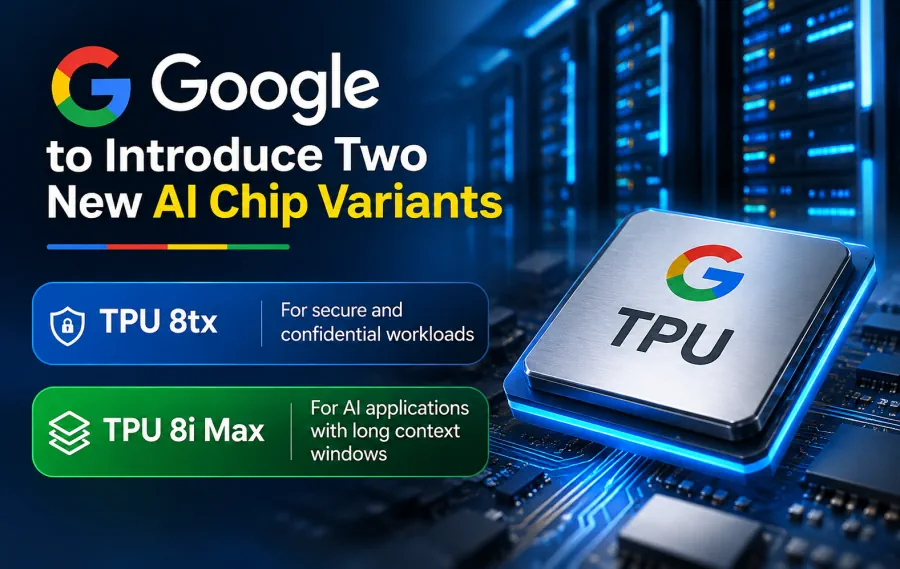
- Google is reportedly preparing to introduce two specialized versions of its in-house Tensor Processing Units (TPUs), named 8tx and 8i Max.
- The 8tx will focus on secure AI computing, while the 8i Max will support applications requiring longer context windows.
- The development strengthens Google’s efforts to compete with Nvidia in the rapidly expanding artificial intelligence chip market.
Alphabet-owned Google is preparing to introduce two specialized variants of its internally developed artificial intelligence chips, expanding its range of computing solutions as competition intensifies in the global AI hardware market.
According to a Bloomberg News report published on Monday, the technology giant plans to offer two configurations of its Tensor Processing Units (TPUs), known as the 8tx and 8i Max, designed to meet different computing requirements among enterprise and government customers.
Also Read:
The announcement comes as technology companies increasingly seek alternatives to Nvidia’s graphics processing units (GPUs), which currently dominate the market for processors used to train and operate advanced artificial intelligence models.
Google’s custom-designed TPUs were originally developed to support its own services and AI infrastructure. However, the company has gradually expanded their availability to external customers, positioning the processors as an alternative to Nvidia’s powerful but expensive chips.
Amin Vahdat, Google’s chief technologist for AI infrastructure, told Bloomberg that the 8tx and 8i Max are not entirely new chip architectures. Instead, they are modified configurations of existing technology, developed in response to specific computing requirements raised by customers.
The TPU 8tx is designed primarily for confidential and security-sensitive computing operations. Its intended users include government agencies, financial institutions and businesses operating in highly regulated industries where protecting sensitive information is a major priority.
The specialized configuration is expected to support AI workloads that require stronger safeguards for confidential data, allowing organizations to adopt advanced artificial intelligence technologies while addressing strict security and regulatory requirements.
Meanwhile, the TPU 8i Max is intended for AI applications that process exceptionally large amounts of information within a single interaction.
These applications rely on extended context windows, which allow AI models to analyze lengthy documents, extensive conversations, complex datasets and large volumes of information while maintaining relevant context.
Long-context processing has become increasingly important as businesses deploy advanced AI systems for software development, document analysis, research and other computationally demanding tasks.
By introducing separate configurations for security-focused and long-context workloads, Google aims to provide more specialized hardware options rather than relying on a single processing solution for every AI application.
The development also reflects a broader shift in the semiconductor industry, where major technology companies are investing heavily in custom-designed processors to improve performance, manage operating costs and reduce dependence on external chip suppliers.
Nvidia remains the leading provider of GPUs for AI computing, benefiting from strong demand among cloud service providers, technology companies and organizations developing large language models.
However, Google’s growing TPU business represents an increasingly significant challenge, particularly as companies look for computing infrastructure tailored to their specific artificial intelligence requirements.
Investors responded positively to the report, with Alphabet shares rising more than 2% in premarket trading on Monday. Despite the increase, the company’s stock had declined approximately 9% since the beginning of the year through the previous market close.
Alphabet had not immediately responded to a request for comment from Reuters, and the reported plans for the two TPU variants had not been independently verified at the time of publication.