Germany Poised to Elect First Female President as Merz Nominates Ilse Aigner
- Chancellor Friedrich Merz has nominated Bavarian conservative Ilse Aigner to succeed President Frank-Walter Steinmeier.
- Aigner is widely expected to secure the presidency with backing from the conservatives, Social Democrats and Greens.
- The 61-year-old politician has pledged to strengthen democratic values and address growing divisions within German society.
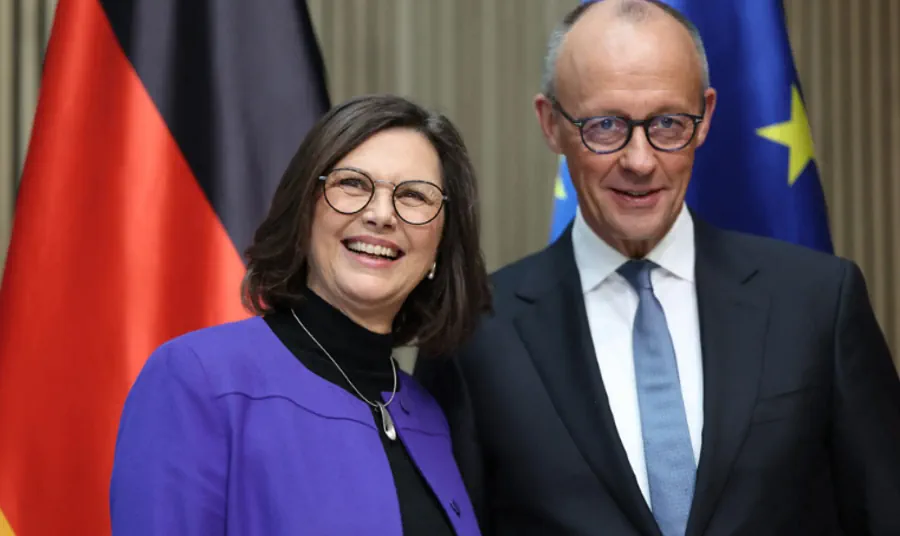
Germany is on course to elect its first female president after Chancellor Friedrich Merz nominated veteran Bavarian politician Ilse Aigner as the conservative bloc’s candidate to succeed outgoing President Frank-Walter Steinmeier.
The announcement, made on Monday, positions Aigner as the leading contender for the country’s highest constitutional office, with support from the major political parties making her election in January highly likely.
Also Read:
Aigner, 61, currently serves as president of Bavaria’s state parliament and previously held a federal cabinet position under former Chancellor Angela Merkel. She belongs to the Christian Social Union (CSU), the Bavarian sister party of Merz’s Christian Democratic Union (CDU).
Her nomination has received backing from Merz’s conservative alliance, the Social Democratic Party (SPD), which shares power in the governing coalition, and the opposition Greens. Their combined support is expected to provide a strong majority in the Federal Convention, the body responsible for electing Germany’s president.
The convention consists of members of the Bundestag, Germany’s lower house of parliament, alongside representatives selected by the parliaments of the country’s 16 federal states.
The presidential election is scheduled for January, ahead of the conclusion of Steinmeier’s term in March. Steinmeier, a Social Democrat, has served as Germany’s head of state since 2017.
Speaking alongside Merz following her nomination, Aigner expressed concern over political polarization and growing threats to democratic institutions. She warned that Germany was facing challenges from extremist movements and ideological divisions that were weakening public confidence and national unity.
Aigner said democratic institutions were coming under pressure from both domestic and international forces, while political extremism was gaining ground and efforts to build consensus were increasingly being undermined.
She pledged to use the presidency to encourage dialogue, strengthen social cohesion and promote respect across political and social differences.
Her remarks come amid growing concerns among Germany’s established political parties over the increasing popularity of the far-right Alternative for Germany (AfD). Opinion polls suggest the party could emerge as the largest political force following the next federal election, currently expected in early 2029.
Chancellor Merz praised Aigner’s political experience and commitment to democratic principles, describing her as a leader capable of bringing people together during a period of heightened political tensions.
He highlighted her opposition to hatred and extremism, saying Germany needed a president who could uphold constitutional values while encouraging constructive public debate.
Merz described Aigner as a politician with dignity, compassion and the ability to provide direction on important national issues.
Although Germany’s presidency is largely ceremonial, the position carries considerable constitutional and symbolic importance. The president formally appoints government ministers, signs legislation into law and represents the country at official events.
The head of state is also expected to serve as an independent moral authority, offering guidance on national challenges and defending democratic principles without becoming directly involved in everyday party politics.
Aigner brings decades of political and administrative experience to the presidential contest. Before entering national politics, she trained as an electrical engineering technician and worked in electrical systems development for helicopter manufacturer Eurocopter.
She began her political career at the local level before winning a seat in the Bundestag in 1998. Her rise through the conservative political ranks eventually led to her appointment as federal agriculture minister under Angela Merkel.
After serving in the federal government, Aigner returned to Bavarian politics and became president of the Bavarian state parliament in 2018, a position she continues to hold.
Her nomination has also attracted positive reactions from political figures outside the conservative alliance.
A senior Social Democratic politician, speaking anonymously to reporters, described Aigner as an experienced and practical leader with the ability to connect with people from different political and social backgrounds.
The Greens also signalled their support, with party leaders encouraging their parliamentary representatives to back her candidacy as a demonstration of cross-party cooperation.
In a letter to party members, the Greens’ leadership emphasized the importance of strengthening social cohesion, mutual respect and Germany’s democratic political centre beyond traditional party divisions.
If elected, Aigner would become the first woman to hold Germany’s federal presidency, marking a historic milestone in the country’s political leadership.