Tesla Begins Work on $10.1 Billion Solar Manufacturing Project in Texas
- Tesla has started preliminary site preparation for its proposed $10.1 billion Project Crystal Sun facility in Texas.
- The 3,050-acre solar manufacturing complex is expected to create more than 9,700 permanent jobs.
- Commercial operations are targeted for early 2029 as Tesla expands its US solar manufacturing ambitions.
Tesla has reportedly begun preliminary construction activities at the site of its proposed $10.1 billion solar manufacturing complex in Texas, marking an important development in the company’s plans to strengthen domestic renewable energy production.
Project Crystal Sun
— Elon Musk (@elonmusk) November 9, 2026
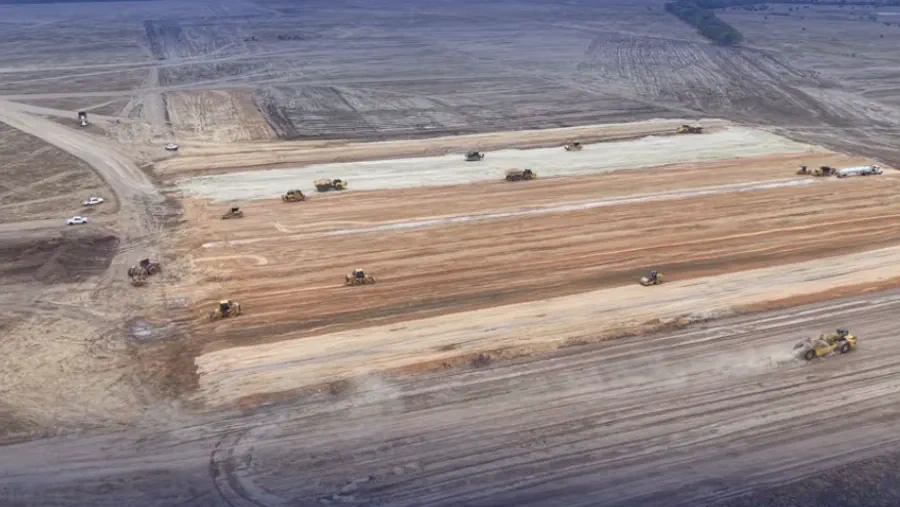
The ambitious development, known as Project Crystal Sun, is planned for Fort Bend County, southwest of Houston. Drone footage circulated on November 9, 2026, showed heavy machinery clearing land, levelling ground and preparing the location for future construction.
Also Read:
Tesla has started construction on Project Crystal Sun, its $10B vertically integrated solar factory near Houston, Texas. The plant will make everything from silicon ingots and wafers to finished cells and panels, with operations targeted for Q1 2029. @SERobinsonJr with a great flyover of the facility:
— TESLARATI (@Teslarati) November 9, 2026
Tesla CEO Elon Musk acknowledged the project following the circulation of the footage on social media. However, the electric vehicle manufacturer has not formally announced a groundbreaking ceremony or confirmed that full-scale construction has commenced.
The proposed facility will cover approximately 3,050 acres near Richmond, Texas, and is designed to become a major centre for solar technology manufacturing in the United States.
Unlike conventional solar panel assembly plants, Project Crystal Sun is intended to integrate several stages of the manufacturing process within a single industrial complex. These operations would include the production of silicon ingots, wafers, photovoltaic cells and finished solar modules.
Photovoltaic cells convert sunlight into electricity and are essential components of solar panels. By producing these materials domestically, Tesla aims to reduce its reliance on imported components while gaining greater control over manufacturing costs and supply chains.
According to the company’s project application, the estimated investment totals approximately $10.116 billion. Of this amount, around $1.5 billion is allocated to real estate, while approximately $8.6 billion is expected to be spent on manufacturing machinery and equipment.
The project has already received significant attention from local authorities because of its potential economic impact, including industrial development, employment opportunities and additional investment in the Houston metropolitan area.
Tesla submitted its application under the Texas Jobs, Energy, Technology and Innovation (JETI) Act in July 2026. The application was subsequently made publicly available through the Texas Comptroller’s office in August.
The proposal gained further momentum in September when Lamar Consolidated Independent School District approved a proposed tax incentive arrangement associated with the development.
On October 22, Fort Bend County commissioners also approved four incentive agreements intended to support the project and improve the financial competitiveness of the Texas location.
These arrangements are designed to reduce certain property tax obligations and encourage large-scale industrial investment. However, the local approvals do not necessarily indicate that all state-level requirements have been completed or that Tesla has made an unconditional commitment to the location.
The company’s application also identified an alternative potential site outside Texas, indicating that location considerations formed part of its broader investment planning.
Under the proposed development schedule, construction activities are expected to continue throughout 2026, 2027 and 2028, with commercial operations targeted to begin during the first quarter of 2029.
Employment projections indicate that the completed manufacturing complex could support approximately 9,712 permanent full-time positions. Recruitment is expected to increase gradually as production expands, with employment growth projected through 2033.
Construction activities could also generate approximately 1,147 temporary jobs at peak activity, providing additional opportunities for contractors, engineers, technicians and other workers involved in developing the facility.
If the investment proceeds as planned, it would establish one of the largest solar manufacturing developments in the United States and significantly expand Tesla’s presence in the American renewable energy industry.
The investment also reflects Elon Musk’s broader strategy of increasing domestic production of solar technologies and reducing dependence on overseas suppliers, particularly China, which currently plays a dominant role in the global solar manufacturing supply chain.
Musk has previously discussed an ambition to establish 100 gigawatts of annual solar manufacturing capacity in the United States through the combined efforts of Tesla and SpaceX.
Although both companies are associated with Musk’s wider energy and manufacturing ambitions, Project Crystal Sun is specifically a Tesla initiative and remains separate from SpaceX’s proposed solar manufacturing developments in Texas.
Tesla’s expansion into solar manufacturing comes at a time when electricity demand is increasing across several major industries, particularly artificial intelligence, cloud computing, data centres and electric transportation.
The rapid development of AI infrastructure has created growing demand for reliable electricity supplies, encouraging technology companies and energy providers to explore additional power generation capacity.
Solar energy is increasingly viewed as an important component of this expansion, particularly when combined with battery storage systems that can help manage electricity availability during periods of fluctuating generation.
Tesla already operates an energy business that includes solar products and battery storage technologies. Its portfolio includes Powerwall systems for residential energy storage and Megapack batteries designed for larger commercial and utility-scale applications.
Expanding domestic solar manufacturing could allow Tesla to strengthen the relationship between its solar generation products and energy storage operations while reducing exposure to international supply disruptions.
The proposed Texas complex would also support the company’s efforts to diversify its business beyond electric vehicles, with renewable energy generation and storage becoming increasingly important areas of investment.
Project Crystal Sun’s planned manufacturing structure could provide Tesla with greater flexibility in sourcing materials, managing production schedules and developing solar products for the American market.
The project’s proposed investment, employment figures and operational timetable remain subject to implementation, regulatory requirements and Tesla’s final development decisions.