Global Oil Prices Fall as Trump Signals Pause in Military Strikes Against Iran
- Brent crude fell to $91.88 per barrel, while US WTI declined to $86.07 as fears of further military escalation eased.
- President Donald Trump indicated that Washington would temporarily hold off on additional strikes against Iran but maintain its naval blockade in the Strait of Hormuz.
- Oil prices have dropped approximately 22% from their October peak, although shipping disruptions and regional tensions continue to pose risks.
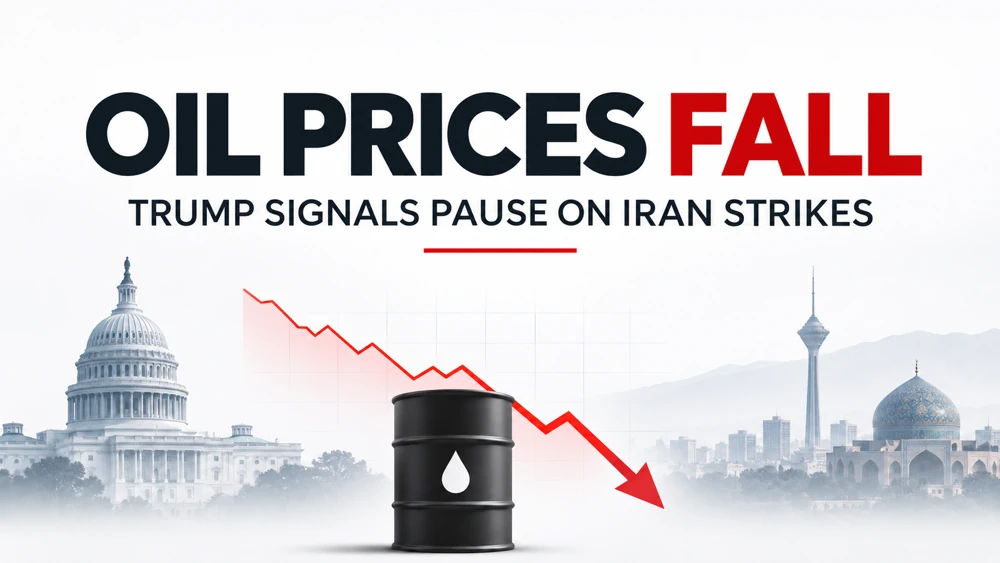
Global oil prices extended their decline on Tuesday as US President Donald Trump’s decision to hold off on further military strikes against Iran eased concerns about prolonged supply disruptions in the Middle East.
International benchmark Brent crude futures dropped 70 cents, or 0.75%, to $91.88 per barrel by 02:46 GMT, while US West Texas Intermediate (WTI) crude futures declined 78 cents, or 0.90%, to $86.07 per barrel.
Also Read:
Both benchmarks had fallen approximately 1% earlier in the trading session, continuing a sharp downward trend that began on Monday.
Brent crude recorded a substantial 5.85% decline in the previous session, briefly touching its lowest level since August 31 as investors reassessed the likelihood of further military confrontation between Washington and Tehran.
The latest decline followed remarks by President Trump on Monday, when he indicated that additional American military action against Iran was not necessary “at this point.”
Trump said his administration had decided to temporarily refrain from launching new strikes following appeals from several Middle Eastern countries seeking to prevent further escalation.
Among those involved in diplomatic efforts was Qatar’s prime minister, who held discussions at the White House as regional governments continued pushing for a reduction in hostilities.
However, the US president made clear that Washington would maintain its naval blockade in the Strait of Hormuz for the time being.
Speaking during an interview with Reuters and later at a White House press briefing, Trump indicated that the United States would continue applying pressure on Iran despite its decision to pause additional military operations.
The Strait of Hormuz remains a critical concern for international energy markets because it serves as one of the world’s most important maritime routes for oil shipments from the Persian Gulf.
Any prolonged disruption to shipping through the strategic waterway could affect global petroleum supplies and increase transportation costs, potentially pushing international crude prices higher.
Market analysts said Trump’s relatively restrained comments had encouraged investors to reduce the geopolitical risk premium previously reflected in oil prices.
Tim Waterer, chief market analyst at KCM Trade, said traders were increasingly responding to the US president’s more conciliatory approach toward Iran following the American midterm elections.
According to Waterer, attacks on commercial shipping near the Strait of Hormuz have continued, but their intensity has not increased sufficiently to trigger another significant rise in oil prices.
The easing of immediate military concerns has therefore allowed investors to focus more closely on global supply conditions and the possibility of diplomatic negotiations.
Additional pressure on crude prices came from signs of increasing production among members of the Organization of the Petroleum Exporting Countries (OPEC).
A Reuters survey indicated that OPEC’s oil production increased during October, with Saudi Arabia, Kuwait and Iraq accounting for much of the growth.
The production gains occurred despite continued restrictions affecting some oil exports, suggesting that additional supplies were entering the market even as geopolitical uncertainty persisted.
The combination of improving supply conditions and reduced expectations of immediate military escalation has contributed to a substantial correction in international oil prices.
Brent crude has now fallen approximately 22% from the six-month high of $118 per barrel reached on October 30.
At that time, concerns that President Trump might intensify military operations against Iran following the US midterm elections had pushed prices higher as traders anticipated potential disruptions to Middle Eastern oil exports.
Those fears have since moderated, particularly after Washington signalled a willingness to avoid additional strikes while diplomatic efforts continue.
Nevertheless, energy market specialists warned that the recent decline does not necessarily indicate that the regional conflict has been resolved.
Gregory Brew, a senior analyst at Eurasia Group, said Brent crude was unlikely to fall sustainably below $90 per barrel without stronger evidence of a lasting reduction in tensions and a potential agreement between the United States and Iran.
He noted that the continued threat to commercial shipping remains a significant concern for international oil markets.
According to Brew, attacks on vessels travelling through the Strait of Hormuz continue to create uncertainty, even as crude prices retreat from their recent highs.
The ongoing naval blockade and the possibility of further incidents involving commercial vessels mean that supply disruptions could still occur despite the temporary pause in additional US military strikes.