Suparco Warns of Worsening Smog in Punjab as Lahore Tops Global Pollution Rankings
- Suparco has warned that smog conditions could worsen across Punjab over the next three days, with satellite data identifying 690 active fire detections in Punjab and neighbouring cross-border areas.
- Seven districts, including Jhang, Narowal, Sheikhupura, Sialkot, Hafizabad, Gujranwala and Dera Ghazi Khan, face high to severe smog conditions.
- Lahore recorded an AQI of 339 on Wednesday morning, while Faisalabad reached a hazardous 686 as authorities intensified action against crop-residue burning.
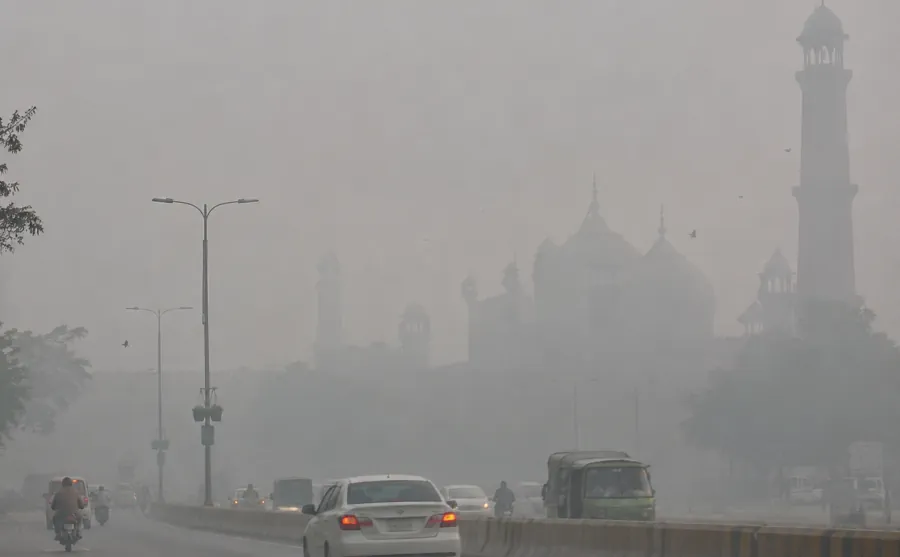
The Pakistan Space and Upper Atmosphere Research Commission (Suparco) has issued a warning of deteriorating smog conditions across Punjab over the next three days, following satellite observations that detected hundreds of active fires and increasing concentrations of atmospheric pollutants.
According to Suparco’s smog assessment dated November 17, satellite monitoring identified 690 active fire detections across Punjab and adjoining transboundary areas during the preceding 24 hours. Of these, 386 were recorded within Punjab, while another 304 were detected across neighbouring regions.
Also Read:
The assessment covered 36 districts of Punjab and used observations from the Visible Infrared Imaging Radiometer Suite (VIIRS) and Moderate Resolution Imaging Spectroradiometer (MODIS) satellite systems to identify fire hotspots and monitor atmospheric conditions.
Seven districts were identified as particularly vulnerable to worsening pollution, including Jhang, Narowal, Sheikhupura, Sialkot, Hafizabad, Gujranwala and Dera Ghazi Khan. These areas are expected to experience high to severe smog levels as unfavourable weather conditions restrict the movement and dispersion of pollutants.
Satellite measurements recorded a mean aerosol optical depth (AOD) of 0.25, an indicator used to assess the concentration of airborne particles in the atmosphere. The highest aerosol concentrations were observed over Chiniot, Jhang and Faisalabad.
The assessment also found that tropospheric nitrogen dioxide (NO2) concentrations were 21% below the average recorded during the corresponding period between 2019 and 2025.
Despite the reduction in nitrogen dioxide levels, Suparco warned that overall air quality could deteriorate further because of poor atmospheric dispersion and the continued presence of particulate pollution.
Forecasts from the Copernicus Atmosphere Monitoring Service (CAMS) indicated that fine particulate matter, known as PM2.5, could reach concentrations of approximately 51 to 71 micrograms per cubic metre.
Suparco noted that model-based pollution estimates are generally lower than readings recorded by ground monitoring stations during winter, when temperature inversions and stagnant atmospheric conditions can trap pollutants close to the surface.
Atmospheric dispersion across the affected areas was assessed as very poor, increasing the likelihood that smoke, dust and other pollutants would remain concentrated near ground level.
The satellite monitoring programme is being used to assess the geographical spread of smog, identify active fire locations and support authorities in tracking pollution trends across Punjab.
Meanwhile, Lahore once again ranked as the world’s most polluted major city on Wednesday morning, with air quality reaching hazardous levels.
According to IQAir’s global pollution rankings, Lahore recorded an Air Quality Index (AQI) of 339 between 10am and 11am, placing the provincial capital at the top of the international list.
Air quality improved during the afternoon, with Lahore’s AQI declining to 167 at 5pm. However, pollution levels began increasing again, reaching 178 by 6pm.
Other cities appearing among the world’s most polluted major cities included Dhaka with an AQI of 221, Baghdad at 199, Tashkent at 182 and Kolkata at 178. Karachi occupied sixth position with an AQI of 174.
Separate real-time air quality readings showed even more severe pollution levels in several Punjab cities, with Faisalabad recording the highest AQI in Pakistan at 686.
Gujranwala followed with an AQI of 550, while Kahna Nau recorded 516, Multan 437 and Kasur 371. Lahore registered 339 during the reporting period.
Other affected cities included Khanewal with an AQI of 327, Sargodha at 314, Sahiwal at 253 and Dera Ghazi Khan at 238.
Under the AQI classification system, readings above 300 are considered hazardous, indicating extremely unhealthy air conditions that can pose serious health risks to the general population.
The Pakistan Meteorological Department (PMD) has also forecast fog and smog in several districts over the next 48 hours, particularly during the morning and nighttime periods.
The affected areas include Lahore, Sialkot, Narowal, Sheikhupura, Okara, Kasur, Faisalabad, Jhang, Khanewal, Multan and surrounding localities.
The Met Office expects predominantly dry weather across most districts of Punjab, with no significant rainfall forecast that could help reduce the concentration of airborne pollutants.
As smog conditions worsen, the Punjab Environment Protection Agency (EPA) has stepped up its campaign against crop-residue burning, a major contributor to seasonal air pollution.
The agency has deployed five senior directors from its headquarters to different divisions of Punjab to directly supervise anti-stubble burning operations.
The officials have been instructed to coordinate with agriculture department teams and district administrations, verify reported fire incidents and ensure timely enforcement action against violations.
Punjab EPA Director General Abdullah Nayyer Sheikh said the deployment was intended to strengthen field monitoring and ensure that reports of crop-residue burning were investigated without delay.
The initiative also aims to improve coordination between environmental authorities and local administrations responsible for preventing agricultural fires.
In Multan, the district administration has received two modern anti-smog gun vehicles following directives from Punjab Chief Minister Maryam Nawaz.
Deputy Commissioner Dr Faisal Saleem said the vehicles would operate around the clock, spraying water in different parts of the city to help reduce airborne dust and pollution.
He said the anti-smog vehicles would be deployed particularly during morning and evening hours, when pollution levels can become more concentrated.
The district administration is also taking enforcement action against individuals involved in burning crop residues and garbage, as part of broader efforts to control local sources of air pollution.