Islam Projected to Become World’s Largest Religion by 2035, Pakistan to Lead Muslim Population by 2070
- Muslims are projected to surpass Christians as the world’s largest religious group by 2035, according to new research published by Pew Research Center.
- The global Muslim population is expected to reach 3.6 billion by 2070, accounting for approximately 36% of the world’s population.
- Pakistan is projected to overtake Indonesia by 2070, with its Muslim population reaching approximately 461 million.
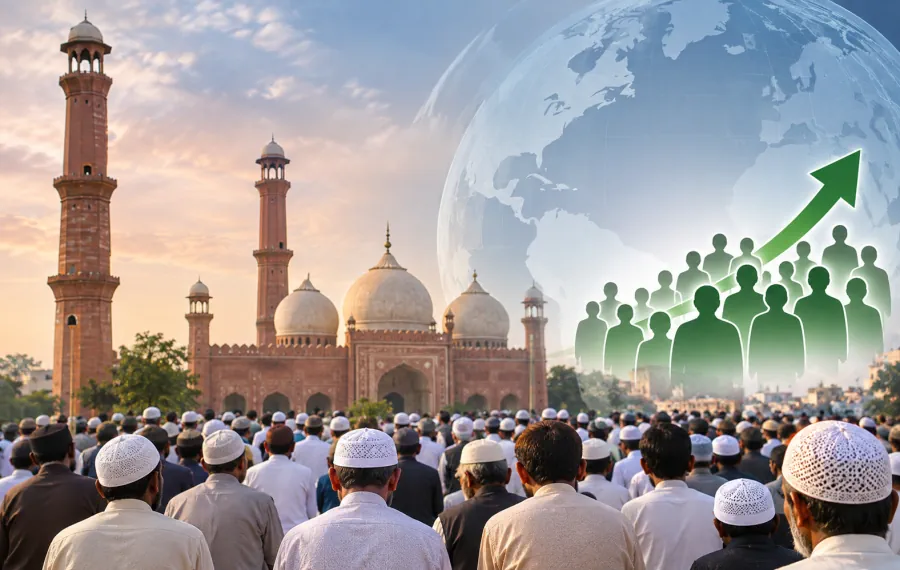
Islam is expected to become the world’s largest religion by population within the next decade, surpassing Christianity by 2035, according to a new demographic study published by the US-based Pew Research Center on November 18, 2026.
The report, titled “The Future of World Religions: Population Growth Projections, 2020–2070,” forecasts significant changes in the global religious landscape over the next five decades, with Muslims expected to experience faster population growth than any other major religious community.
Also Read:
According to the study, the global Muslim population is projected to increase by approximately 80% between 2020 and 2070, compared with an estimated 11% increase among non-Muslims. By 2070, Muslims are expected to number approximately 3.6 billion, representing 36% of the world’s population.
The research identifies higher fertility rates and a relatively younger population as the main factors behind the projected growth. Around 60% of Muslims worldwide were under the age of 30 in 2020, compared with fewer than half of non-Muslims.
The study also estimates that Muslim women had an average fertility rate of 3.1 children during the 2020–2025 period, compared with 2.0 among non-Muslim women. These demographic differences are expected to contribute significantly to the expansion of the global Muslim population.
Pakistan is expected to undergo one of the most notable changes in the global Muslim population rankings. According to Pew Research Center, Pakistan could become the country with the largest Muslim population by 2070, overtaking Indonesia, which currently holds the leading position.
Pakistan’s Muslim population is projected to reach approximately 461 million by 2070, compared with an estimated 227 million in 2020. The country would account for nearly 13% of Muslims worldwide.
India is expected to rank second with approximately 334 million Muslims, followed by Nigeria with 282 million and Indonesia with approximately 274 million.
The study also forecasts substantial growth in Africa, particularly in sub-Saharan countries, where the Muslim population is expected to more than double from 369 million in 2020 to approximately 980 million by 2070.
By that year, sub-Saharan Africa could account for 27% of the world’s Muslims, compared with 18% in 2020. Meanwhile, the Asia-Pacific region’s share of the global Muslim population is projected to decline from 59% to approximately 50%, despite continued growth in absolute numbers.
North America is also expected to experience significant growth in its Muslim population, increasing from approximately 6 million in 2020 to 20 million by 2070. Migration is expected to contribute substantially to this increase.
The report further projects that 54 countries and territories will have Muslim-majority populations by 2070, compared with 53 in 2020. Ivory Coast is expected to become an additional Muslim-majority country.
Pew Research Center developed its projections using demographic information from national censuses, population surveys and international datasets covering 201 countries and territories. The calculations consider fertility, mortality, migration, age distribution and changes in religious affiliation.
The researchers emphasised that these estimates represent possible demographic outcomes if existing trends continue, rather than guaranteed predictions of future religious populations.