Gulf Stock Markets Close Higher as Investors Monitor Iran War and Strait of Hormuz Risks
- Saudi Arabia’s stock market rose 1.4%, while Dubai and Abu Dhabi gained 0.8% and 0.3%, respectively, amid hopes of easing regional tensions.
- Investors remained cautious over the US-Israeli conflict with Iran, particularly threats to oil shipments and energy infrastructure in the Strait of Hormuz.
- Qatar’s stock market declined 0.5%, while Saudi authorities reported intercepting missiles and a drone launched by Houthi forces.
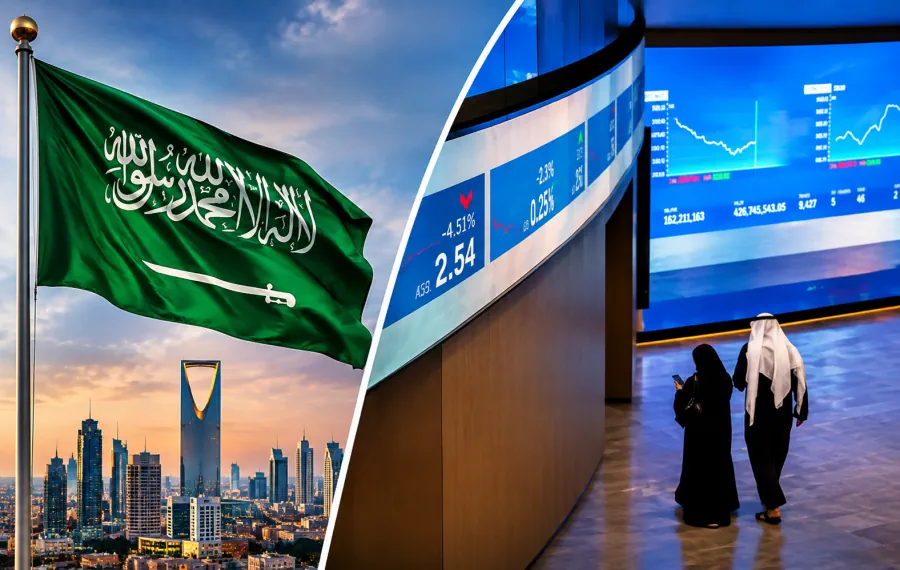
Most Gulf stock markets ended Wednesday, November 11, 2026, in positive territory as investors weighed signs of a possible easing in the US-Israeli conflict with Iran against continuing security threats to regional energy infrastructure and shipping routes.
Trading sentiment improved across several major exchanges as diplomatic efforts raised expectations of reduced hostilities. However, recent attacks involving oil tankers in the Strait of Hormuz and energy facilities elsewhere in the region continued to raise concerns about the possibility of renewed military escalation.
Also Read:
Saudi Arabia’s benchmark stock index recovered from early losses to finish 1.4% higher, supported by gains in major companies. State-owned energy giant Saudi Aramco advanced 1.6%, contributing to the broader market recovery.
The Saudi market also recorded significant movements in individual stocks. Supermarket operator Abdullah Al Othaim Markets Company surged 7.1% after reporting a narrower quarterly loss compared with the previous quarter.
In contrast, Advanced Building Industries Company declined 6.5%, making it the worst-performing stock on the benchmark index following a sharp fall in its third-quarter earnings.
Dubai’s main stock index gained 0.8%, with banking shares providing important support. Emirates NBD, one of the region’s largest lenders, climbed 4.3%, helping lift the overall market.
Abu Dhabi’s benchmark index also registered a modest increase, closing 0.3% higher as investors maintained a cautious but generally positive outlook.
Qatar moved against the broader regional trend, with its benchmark index falling 0.5%. The decline was largely driven by petrochemical producer Industries Qatar, whose shares dropped 1.4%.
Outside the Gulf region, Egypt’s blue-chip stock index ended the session largely unchanged. However, Eastern Company, the country’s dominant tobacco producer, gained 4.2% after announcing a substantial improvement in third-quarter profits.
Market analysts said investors were closely following diplomatic developments while remaining concerned about the security of critical energy transportation routes.
Ranim Turfa, head of research and market analysis for the Middle East and North Africa at Tickmill, said Gulf markets generally moved higher as traders evaluated regional security developments and the possibility of progress in mediation efforts.
She noted that although some encouraging diplomatic signals had emerged, the threat of further escalation continued to limit investor confidence.
According to Turfa, uncertainty surrounding energy shipments through important maritime corridors remained a major factor influencing market sentiment. Investors were particularly focused on whether diplomatic initiatives could deliver meaningful and lasting improvements in regional security.
The Strait of Hormuz remains central to these concerns because it serves as one of the world’s most important maritime routes for oil and liquefied natural gas exports. Any prolonged disruption to shipping through the waterway could affect international energy supplies, transportation costs and global commodity markets.
The latest market movements came against a backdrop of additional security incidents in Saudi Arabia, where the Saudi-led coalition reported intercepting several aerial threats attributed to Yemen’s Houthi forces.
According to the coalition, air defence systems intercepted two missiles targeting Riyadh, including one ballistic missile and one cruise missile.
Authorities also reported intercepting another ballistic missile directed toward Saudi Arabia’s southern region, along with a drone detected over the country’s oil-rich eastern area.
Civil defence warnings were issued in Riyadh and the southern cities of Abha and Khamis Mushait as security forces responded to the threats.
Residents were subsequently informed that the immediate danger had passed following the reported interceptions.
The incidents added to concerns about the vulnerability of Gulf energy facilities and transportation networks at a time when investors were already closely monitoring the broader conflict involving Iran and the United States and Israel.
Despite the continuing security challenges, Wednesday’s gains across Saudi Arabia, Dubai and Abu Dhabi reflected cautious optimism among investors that diplomatic efforts could help reduce regional tensions and limit further disruption to energy markets.