Egypt Train Collision Kills Seven, Injures 112 Near Cairo
- At least seven people were killed and 112 injured after two passenger trains collided in Egypt’s Giza governorate, south of Cairo.
- Several railway carriages overturned, leaving passengers trapped as emergency teams and local residents carried out rescue operations.
- President Abdel Fattah al-Sisi ordered an urgent investigation and called for accountability over any negligence that may have contributed to the accident.
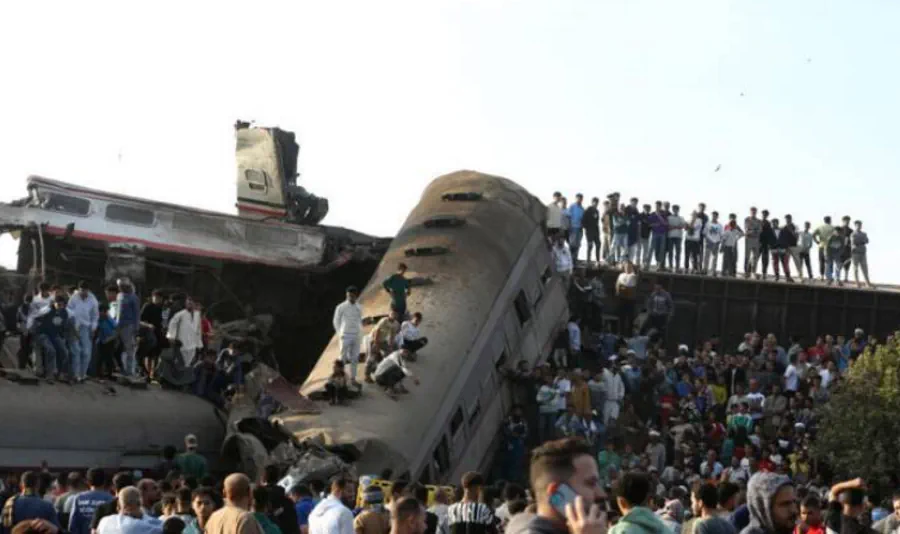
At least seven people were killed and 112 others injured after two passenger trains collided south of Egypt’s capital, Cairo, on Sunday, causing several carriages to derail and triggering a major emergency response.
The collision occurred in the Al-Ayyat area of Giza governorate when a passenger train travelling from Giza to Fayoum struck the rear of another train operating on the Cairo-Aswan route, according to Egypt’s railway authority.
Also Read:
The impact caused multiple carriages to overturn, leaving passengers trapped inside damaged compartments and scattering debris across railway tracks and nearby agricultural land.
Egypt’s Ministry of Health confirmed that 112 people sustained injuries and were receiving treatment at hospitals across the Giza area.
According to the ministry, the injuries ranged from relatively minor bruises and abrasions to serious fractures affecting the arms, legs, pelvis and vertebrae. Several passengers also suffered head and facial wounds, chest injuries and other trauma.
Health officials said 45 injured passengers had been discharged after receiving medical treatment, while another seven were expected to leave hospital following further assessments.
Egyptian President Abdel Fattah al-Sisi expressed serious concern over the tragedy and instructed the relevant authorities to launch an immediate investigation into the circumstances surrounding the collision.
The president also directed officials to identify any failures or negligence that may have contributed to the accident and ensure that those responsible were held accountable.
Eyewitnesses described scenes of panic and confusion immediately after the crash, as passengers attempted to escape damaged carriages while residents from nearby villages rushed to assist the injured.
Abdel Wahed Mohamed, a 31-year-old witness who was sitting at a nearby café when the accident occurred, said the Aswan-bound train had stopped before the second train struck it from behind.
He recalled that the collision occurred at approximately 1:30pm and caused six carriages to overturn.
According to Mohamed, several victims suffered serious injuries, including head wounds and broken limbs, as passengers struggled to escape the wreckage.
Another witness, 25-year-old Ahmed Moussa, described how rescue workers and local residents attempted to reach people trapped beneath an overturned carriage.
He said rescuers were forced to dig underneath the damaged compartment to access passengers who had become trapped inside.
“There were people piled on top of each other inside,” Moussa said, adding that he had seen two women among those who lost their lives.
Taha Abdel Tawab, 43, described another distressing scene, saying he witnessed a young man emerging from the wreckage while carrying the body of his father.
Journalists at the accident site reported seeing several passenger carriages scattered across the railway tracks and surrounding farmland.
One carriage had overturned beside the railway embankment, while another was severely damaged, with part of its structure torn open by the force of the impact.
Twisted metal, broken seats and passengers’ personal belongings were visible among the wreckage, illustrating the severity of the collision.
Emergency services deployed ambulances, cranes and heavy machinery to the accident site as rescue teams worked to recover victims and reposition overturned railway carriages.
Medical teams transported injured passengers to nearby hospitals, while railway workers and emergency personnel continued searching damaged compartments for anyone who might still be trapped.
Local villagers also joined the rescue efforts, helping emergency responders reach victims and remove debris from the damaged carriages.
Rescue and recovery operations continued into the evening, with authorities cordoning off the accident site as heavy equipment was brought in to clear the railway tracks.
Reda Kamel Labib, a resident of the surrounding area, said one of those killed belonged to a nearby village.
He criticized delays in rescue operations, attributing some of the difficulties to inadequate transport infrastructure in the area, which he said complicated access for emergency vehicles.
Images from the scene showed first responders and members of the public carrying a victim’s body from the wreckage in a black body bag.
Egyptian authorities confirmed that an investigation had been initiated to determine the precise cause of the collision, including the circumstances that allowed one train to strike another from behind.
The accident occurred in Al-Ayyat, an area with a history of devastating railway incidents.
In 2002, Egypt experienced its deadliest railway disaster when a fire spread through a passenger train carrying holiday travellers south of Cairo, killing more than 370 people.
The Al-Ayyat area was also the scene of multiple railway accidents in 2009 that resulted in dozens of deaths, raising longstanding concerns about railway safety and operational standards.
Egypt operates one of Africa’s largest railway networks, which serves as a vital transportation system for its population of approximately 110 million people.
Millions of passengers depend on rail services for daily travel and long-distance journeys, particularly between Cairo and cities across Upper Egypt.
However, the country’s railway system has experienced repeated fatal accidents over the years, with ageing infrastructure and safety shortcomings remaining major challenges.
Over the past decade, the Egyptian government has invested billions of dollars in transportation development, including the construction of new highways, modern railway projects and high-speed train networks.
Despite these investments, significant portions of the country’s conventional railway infrastructure remain in need of modernization, while recurring accidents continue to raise concerns about passenger safety and the reliability of existing rail services.