China Tests AI-Powered Truck Convoys With One Driver Leading Multiple Vehicles
- China is advancing autonomous truck platooning technology that allows one human-driven truck to lead several AI-powered vehicles.
- Companies including Pony.ai, SANY and Geely Farizon are developing and testing coordinated truck convoys for commercial freight transportation.
- The technology aims to reduce transportation costs, improve logistics efficiency and address driver shortages, although wider deployment remains subject to safety testing and regulatory approval.
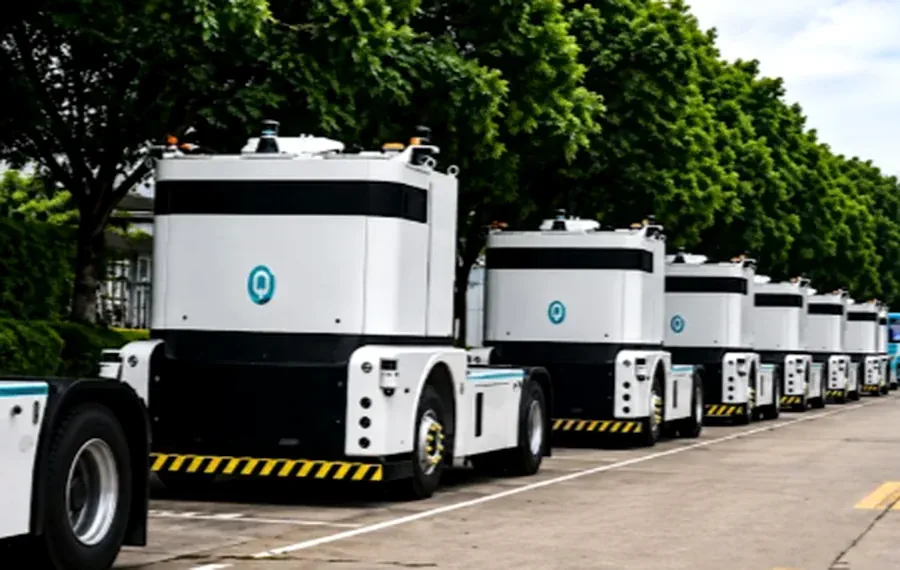
China is making progress in autonomous freight transportation, with artificial intelligence-powered truck convoys being developed to allow a single human driver to lead multiple heavy vehicles along highways and designated logistics routes.
The technology, commonly known as autonomous truck platooning, enables several trucks to travel together in a coordinated formation. While a professional driver operates the leading vehicle, the following trucks use automated driving systems to maintain their positions, adjust speeds and respond to changing road conditions.
Also Read:
Chinese autonomous driving company Pony.ai has been among the companies developing this technology. In December 2024, the company received approval to conduct cross-provincial autonomous truck platooning tests on highways connecting Beijing, Tianjin and Hebei.
The approval, announced in January 2025, allowed testing of a system in which the lead truck operates with a human safety operator while following vehicles can travel without drivers behind their steering wheels.
The testing programme included the Beijing–Tianjin–Tanggu Expressway, an important transportation corridor linking industrial and commercial centres in northern China.
The system follows a model known as “1+N,” in which one human-operated lead truck guides multiple autonomous vehicles travelling in the same convoy.
Unlike conventional freight transportation, where every truck requires a separate driver, the technology allows following vehicles to use artificial intelligence, sensors and communication systems to coordinate their movements with the lead vehicle.
Chinese heavy equipment manufacturer SANY has also collaborated with Pony.ai on autonomous trucking technology, including a system designed to operate five trucks together with one lead vehicle and four autonomous following trucks.
Known as the “1+4” model, the arrangement is intended to improve freight transportation efficiency, particularly on long-distance routes and in industrial logistics operations.
SANY has reported promising results from its autonomous trucking development programme, including estimates suggesting that coordinated operations could reduce transportation costs per kilometre by approximately 29%.
The company has also projected significant improvements in fleet profitability, although these estimates are based on its own assessments and should not be considered guaranteed results for commercial operators.
The technology relies on several interconnected systems, including cameras, positioning technology, automated vehicle controls and communication equipment that allows trucks to exchange information while travelling.
When the lead truck accelerates, slows down or changes its movement, the following vehicles use automated systems to adjust their speed and maintain appropriate distances.
More advanced versions are being developed to support additional driving functions, including lane changes and responses to obstacles.
China has also explored autonomous truck platooning in port logistics, where vehicles operate along more predictable routes than those typically encountered on public highways.
At Shanghai’s Yangshan Port, researchers have documented the use of human-led autonomous truck platooning technology in container transportation operations.
Research published in Communications Engineering described a system handling more than 200,000 twenty-foot equivalent containers annually, demonstrating how automated convoys can be used in commercial logistics environments.
The technology is also being developed for electric heavy-duty vehicles. In August 2026, Geely Farizon and autonomous driving company Trunk Technology completed coordinated testing involving five battery-electric trucks at an intelligent highway testing facility in China’s Shandong province.
The demonstration involved one leading vehicle and four following trucks operating as a coordinated convoy, with further evaluations planned under different road and environmental conditions.
The development of autonomous trucking comes as logistics companies seek ways to manage rising transportation costs, improve operational efficiency and reduce dependence on large numbers of drivers.
Truck platooning could also improve the utilisation of freight vehicles by allowing several trucks to operate together under coordinated supervision.
However, autonomous truck convoys remain subject to technical and regulatory limitations. Their performance must be assessed under different traffic conditions, including heavy congestion, adverse weather and unexpected obstacles.
Reliable vehicle communication, accurate positioning and effective emergency response systems are particularly important for maintaining safe distances between trucks travelling in formation.
Although China has made progress in testing and deploying autonomous trucking technology in selected logistics environments, the systems are not yet in unrestricted nationwide operation.
The development programmes currently involve different levels of automation, ranging from supervised testing on public highways to commercial operations within designated logistics facilities.