Supreme Court Rules Life Imprisonment Must Involve at Least 15 Years in Jail, Orders Murder Convict’s Return
- The Supreme Court has ordered murder convict Gul Nawab to return to prison after ruling that his release following nine years of imprisonment did not satisfy the minimum 15-year requirement.
- A three-member bench observed that presidential pardons and remissions for good conduct cannot reduce the actual imprisonment period below 15 years in a life sentence.
- The ruling could affect thousands of prisoners in Khyber Pakhtunkhwa, while the court has advised the convict’s lawyer to seek a review and adjourned proceedings for four weeks.
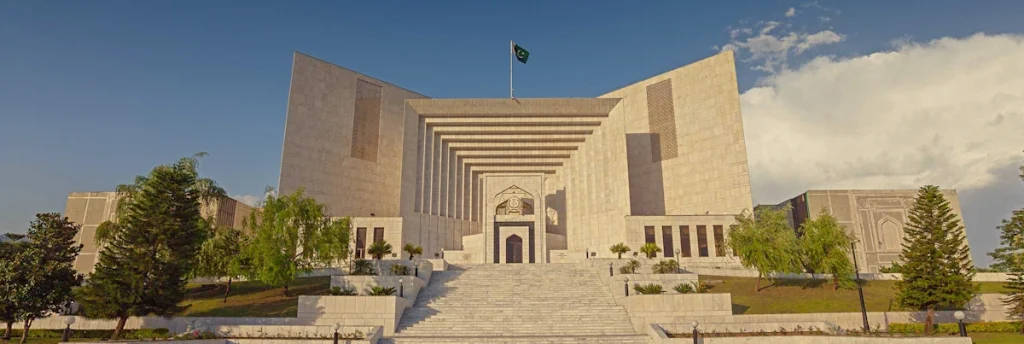
The Supreme Court of Pakistan has delivered a significant ruling on the minimum duration of life imprisonment, ordering a murder convict who was released after serving nine years to return to prison despite having received sentence remissions.
A three-member bench headed by Justice Hashim Kakar ruled that a person sentenced to life imprisonment must serve at least 15 years in prison, observing that reductions granted through presidential pardons or good conduct cannot bring the actual period of imprisonment below that threshold.
Also Read:
The ruling came during proceedings involving Gul Nawab, a murder convict who had been released after authorities calculated various remissions against his life sentence.
The bench questioned the legality of his release, observing that he had not completed the minimum period of imprisonment required under the applicable legal principles and judicial precedents.
During the hearing, Justice Hashim Kakar expressed concern over how a person convicted of murder could be released after spending only nine years behind bars.
He maintained that life imprisonment carried a minimum custodial requirement and that sentence reductions could not be applied in a manner that effectively eliminated that obligation.
The judge also questioned sentencing practices in murder cases, particularly the tendency of the Peshawar High Court to order multiple sentences to run concurrently.
Justice Kakar observed that whether an individual had committed one murder or four, sentences were frequently ordered to run simultaneously rather than consecutively.
He raised concerns about the implications of such practices, emphasizing that convictions for serious offences such as murder must result in meaningful imprisonment.
The judge further commented on the criminal justice situation in Khyber Pakhtunkhwa, describing widespread injustice in the province and observing that conviction rates in murder cases were reportedly as low as one to two per cent.
Representing Gul Nawab, Advocate Shabbir Hussain Gigyani argued that his client had originally received a life sentence but had subsequently qualified for substantial reductions in his imprisonment period.
According to the lawyer, the convict had accumulated approximately 16 years of sentence remissions through good conduct and a presidential pardon.
He maintained that these reductions had been calculated under the applicable rules, leading prison authorities to conclude that his client had completed the required sentence and was eligible for release.
Gigyani referred to several earlier Supreme Court judgments in support of his argument, contending that the remission calculations were consistent with established legal interpretations.
Justice Hashim Kakar, however, rejected the lawyer’s reliance on those precedents, indicating that the legal position had to be assessed in light of the bench’s understanding of the law.
The lawyer objected to the order directing his client back to prison and warned that the decision could have serious consequences for prisoners throughout Khyber Pakhtunkhwa.
He argued that the ruling extended beyond Gul Nawab’s individual case because numerous prisoners had received remissions and were awaiting release based on similar sentence calculations.
According to Gigyani, the decision had effectively prevented the release of thousands of prisoners who believed they had completed their sentences after accounting for legally available reductions.
The lawyer also referred to a previous federal emergency in Khyber Pakhtunkhwa, arguing that the latest judicial decision had created an emergency-like situation within the province’s prison system.
He maintained that uncertainty over the treatment of remissions could affect a substantial number of inmates and their eligibility for release.
Responding to these concerns, Justice Salahuddin Panhwar said that if the lawyer believed the ruling had resulted in injustice, the judges would take responsibility for examining the matter.
Justice Ishtiaq Ibrahim advised the defence counsel to file a review petition, assuring him that the court would consider the arguments presented through the appropriate legal procedure.
Justice Hashim Kakar, however, made a pointed observation during the exchange, telling the lawyer to consider his proposed review petition rejected in advance.
The proceedings also brought attention to the rights of murder victims’ families and the extent of the state’s authority to reduce criminal sentences.
Justice Ishtiaq Ibrahim questioned the consequences of repeated presidential pardons and sentence remissions for the families of people killed in murder cases.
He observed that the right to forgive a murderer belonged to the legal heirs of the victim and raised concerns about the state exercising powers that could undermine those rights.
The judge questioned whether the executive branch should be able to reduce or waive punishments imposed by courts in a manner that affected the interests of victims’ families.
He emphasized that the legal rights of victims’ heirs must be respected when considering sentence reductions and pardons in murder cases.
The bench maintained that neither presidential clemency nor remissions awarded for good behaviour could reduce the actual period of imprisonment under a life sentence to less than 15 years.
The court’s observations have brought renewed attention to the distinction between the sentence imposed by a court and the period a prisoner actually serves after receiving statutory or executive remissions.
The issue is particularly significant in cases involving life imprisonment, where the calculation of sentence reductions can determine when a convicted person becomes eligible for release.
The Supreme Court directed Advocate Shabbir Hussain Gigyani to pursue a review petition if he intended to challenge the decision ordering Gul Nawab’s return to prison.
The three-member bench subsequently adjourned further proceedings for four weeks.
The ruling has raised concerns about its potential implications for other prisoners whose release dates have been calculated using presidential pardons and good-conduct remissions, particularly in Khyber Pakhtunkhwa, where the defence counsel claimed thousands of inmates could be affected.