Rs24.9 Billion, 100MW Solar Project Fast-Tracked to Tackle Gilgit-Baltistan Power Crisis
- Ahsan Iqbal has ordered faster implementation of a Rs24.9 billion, 100MW solar project in Gilgit-Baltistan.
- Authorities will develop solar installations, transmission infrastructure and access roads simultaneously.
- The government will also review tourism taxation and measures to control unplanned development.
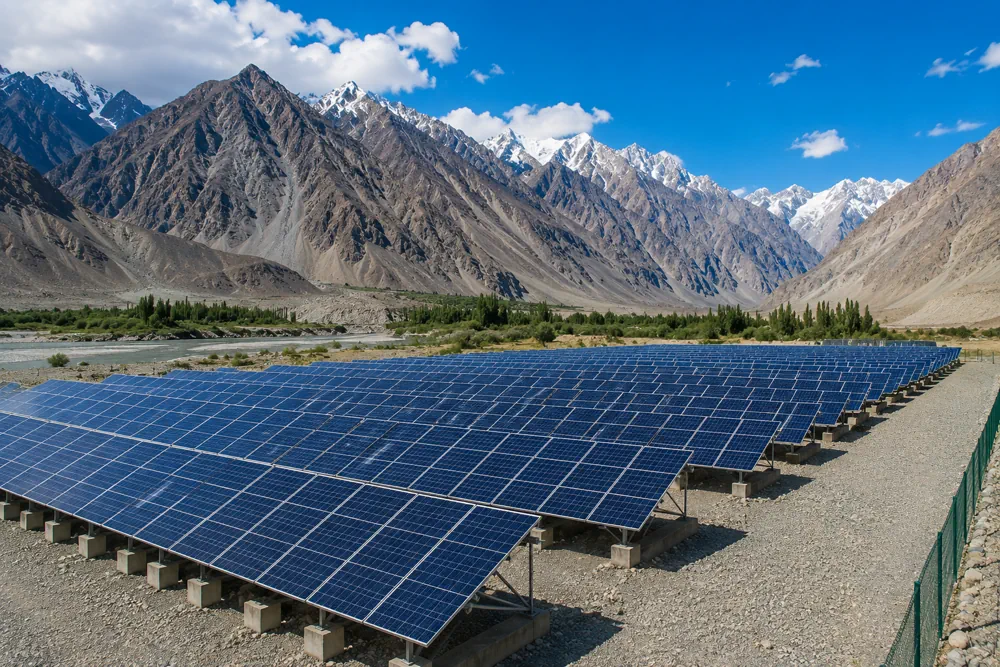
ISLAMABAD: Federal Planning Minister Ahsan Iqbal has ordered fast-track implementation of a Rs24.9 billion, 100-megawatt solar power project in Gilgit-Baltistan, describing electricity shortages as the region’s “number one crisis” and directing federal and regional authorities to avoid delays by executing different components simultaneously.
The directions were issued during the second meeting of the Prime Minister’s Committee formed to review Gilgit-Baltistan’s development concerns and prepare recommendations for accelerating development in the region.
Also Read:
The meeting was attended by Gilgit-Baltistan Chief Minister Amjad Hussain Azaar, the opposition leader in the GB Assembly, senior federal and regional government officials and Federal Minister for Power Sardar Awais Ahmad Khan Leghari, who participated virtually.
A major focus of the meeting was the Rs24.9 billion Public Sector Development Programme project for the installation of “100 MW Distributed Solar Photovoltaic Plants at Various Sites in Gilgit-Baltistan.”
The project includes rooftop and utility-scale solar installations as well as the transmission lines and access roads required to support them.
Ahsan Iqbal declared the solar project a high-priority initiative for addressing GB’s acute electricity shortage and directed authorities to accelerate its implementation.
Instead of completing the solar, transmission and road components one after another, the planning minister ordered the federal government and Gilgit-Baltistan authorities to carry out their respective portions simultaneously.
The GB government was directed to immediately begin work on access roads and transmission infrastructure falling under its responsibility.
Ahsan Iqbal also ordered third-party validation to take place alongside construction and implementation. This would allow independent checks on quality and compliance without stopping or delaying ongoing work.
“Energy is the number one crisis in Gilgit-Baltistan,” the minister said, stressing that the region could not afford even a single day of unnecessary delay given the difficulties electricity shortages were creating for residents.
Authorities were directed to maintain close coordination and remove procedural hurdles that could slow the project.
The meeting was also informed that two other major energy projects in Gilgit-Baltistan were approaching completion. The Rs10.6 billion Naltar Power Project was nearing completion, while the Rs12.9 billion Hanzel Power Project had also reached an advanced stage.
Alongside the energy situation, the government reviewed the rapid growth of tourism in Gilgit-Baltistan and concerns about increasing pressure on the region’s fragile ecosystem.
Ahsan Iqbal directed the GB government to consider an appropriate taxation and regulatory system for tourism that could generate additional revenue while promoting environmentally sustainable development.
He warned that uncontrolled tourism and construction could put considerable pressure on the region’s natural environment.
The planning minister therefore ordered a comprehensive carrying-capacity study to determine how much tourism Gilgit-Baltistan’s environment can sustainably accommodate.
He proposed forming a task force involving the Ministry of Kashmir Affairs and Gilgit-Baltistan, the Ministry of Climate Change and the GB government, supported by relevant experts and institutions including the Aga Khan Development Network.
The task force would study the issue and recommend measures to regulate tourism, discourage unplanned construction and preserve GB’s ecological balance.
A separate committee comprising representatives and experts from the Federal Board of Revenue, Finance Division and GB government was also proposed to help develop and implement an appropriate taxation framework for the tourism sector.
The meeting further examined Gilgit-Baltistan’s wider financing challenges. Ahsan Iqbal said the Planning Ministry had recommended to the prime minister in February 2025 that GB should receive a financing framework similar to arrangements available to provinces under the National Finance Commission mechanism.
He said financing requirements for ongoing PSDP projects across the country stood at approximately Rs3 trillion against available fiscal space of around Rs1 trillion, contributing to project delays and significant cost escalation.
The minister said a sustainable financial framework was needed to provide Gilgit-Baltistan and Azad Jammu and Kashmir with equitable financing arrangements. Until the NFC Award is finalised, he said alternative financing options should be examined to meet GB’s immediate development requirements.
The meeting also reviewed issues involving revenue, regulatory frameworks, institutional capacity and other development projects in the region.
Ahsan Iqbal directed officials to consolidate the decisions and recommendations emerging from the meeting into an interim report within two weeks.
He instructed all relevant ministries, departments and the Gilgit-Baltistan government to accelerate work, improve inter-agency coordination and submit progress within the prescribed timelines.