PPL Plans $40 Million Deep Drilling Project at Sui Gas Field to Explore 2 TCF Reserves
- Pakistan Petroleum Limited plans to drill a 6,000-metre-deep exploratory well at the Sui gas field in FY2027-28, targeting an estimated 2 trillion cubic feet of natural gas.
- The company expects production to increase from 649 MMscfde in FY2025-26 to approximately 680 MMscfde in FY2026-27, supported by new discoveries and development projects.
- Two upcoming gas processing facilities, Zafir and Pateji, are expected to add domestic gas supplies, with the Pateji project projected to generate around Rs8 billion in revenue.
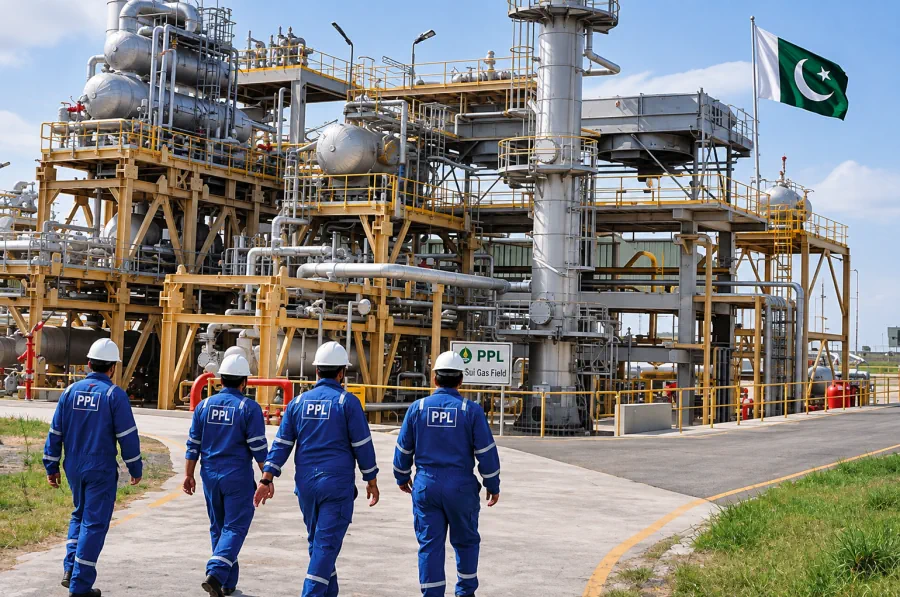
Pakistan Petroleum Limited (PPL), one of Pakistan’s leading oil and gas exploration companies, is preparing a major deep drilling project at the Sui gas field in Balochistan, with an estimated investment of $35 million to $40 million aimed at discovering additional natural gas resources.
The company plans to drill an exploratory well reaching approximately 6,000 metres below the surface during the financial year 2027-28, targeting a potential gas resource estimated at around 2 trillion cubic feet (TCF).
Also Read:
The development was disclosed during an analyst briefing held on Wednesday, November 11, 2026, with details subsequently outlined in a research report by brokerage firm Arif Habib Limited (AHL).
According to the report, the proposed Sui Deep exploration project represents an important component of PPL’s strategy to identify new hydrocarbon resources and compensate for declining production from its existing mature gas fields.
The planned well will target deeper geological formations beneath the established Sui gas field, which has historically played a significant role in meeting Pakistan’s domestic natural gas requirements.
However, the exploration programme is expected to involve considerable technical challenges because of the high-temperature and high-pressure conditions anticipated at the targeted drilling depth.
Such conditions require specialised drilling equipment, advanced well-control systems and additional engineering precautions, contributing to the project’s estimated capital expenditure of $35 million to $40 million.
The targeted 2 TCF represents an exploration objective rather than confirmed recoverable reserves. The actual quantity and commercial viability of any gas discovery will depend on drilling results and subsequent technical assessments.
PPL’s planned investment comes as the company works to address natural production declines across its established oil and gas assets.
According to the analyst briefing, the company’s mature fields are experiencing annual natural depletion rates of approximately 8% to 9%, creating a continuing need for new discoveries, development drilling and additional production infrastructure.
To counter these declines, PPL is pursuing several exploration and development projects intended to stabilise production and increase the volume of gas supplied to the domestic energy market.
The company expects its overall production to rise to approximately 680 million standard cubic feet of gas equivalent per day (MMscfde) during FY2026-27, compared with 649 MMscfde recorded in FY2025-26.
This represents a projected increase of around 31 MMscfde, or approximately 4.8%, in annual production levels.
The report also indicated that PPL expects to add approximately 33 MMscfde of incremental production during FY2026-27 through a combination of new discoveries and ongoing field development activities.
The anticipated increase will primarily come from several exploration and development locations, including Baragzai in the Nashpa area, Latif-25, Makori East, Tolanj West and Rehman-9 in the Kirthar Block.
These projects are expected to contribute additional hydrocarbon production as development activities progress and newly discovered resources are connected to existing infrastructure.
According to the report, development work at the identified fields is expected to contribute approximately 17 million standard cubic feet per day (MMscfd) of additional gas production.
Alongside exploration and drilling activities, PPL is advancing gas processing infrastructure to bring newly developed gas resources into the domestic supply network.
One of the company’s key upcoming projects is the Zafir gas processing plant, which is scheduled to begin operations in December 2026.
The facility is expected to initially supply approximately 20 MMscfd of sales gas, with production capacity planned to increase to around 40 MMscfd during its second development phase.
PPL holds a 65% working interest in the Zafir project, making it an important part of the company’s near-term production expansion plans.
The commissioning of the facility is expected to support the commercialisation of available gas resources by processing raw natural gas into a form suitable for supply to the market.
Another important project under development is the Pateji gas processing plant in Sujawal, Sindh.
Construction of the facility is currently underway, with commissioning expected by June 2027.
Once operational, the Pateji plant is projected to contribute approximately 16 MMscfd of additional sales gas to the domestic market.
The project is also expected to generate approximately Rs8 billion in revenue, according to the analyst report.
The development of both Zafir and Pateji forms part of PPL’s broader efforts to expand production capacity and improve the commercial utilisation of its gas discoveries.
These investments come at a time when Pakistan continues to face challenges in maintaining sufficient domestic natural gas supplies, particularly as production from several established fields declines.
New exploration projects and processing facilities are therefore becoming increasingly important for energy companies seeking to maintain output and reduce the impact of natural reservoir depletion.
PPL’s planned deep drilling programme at Sui is particularly significant because of the field’s longstanding importance to Pakistan’s natural gas industry.
The Sui field, located in Balochistan, has been one of the country’s major sources of natural gas for decades, supplying fuel for households, industries and power generation.
Exploring deeper geological formations could provide opportunities to identify additional resources beneath the existing producing reservoirs, although the outcome remains uncertain until exploration drilling is completed.
With the Sui Deep project targeted for FY2027-28 and new processing facilities expected to begin operations over the coming months, PPL is pursuing both near-term production improvements and longer-term exploration opportunities to support its domestic gas portfolio.