Pakistan Calls for More Inclusive Global Order as Major Power Rivalries Intensify: Ishaq Dar
- Deputy Prime Minister Ishaq Dar urges a more representative multipolar world order based on international cooperation, diplomacy and respect for global rules.
- Pakistan highlights its diplomatic engagement with the US, Iran, China and regional partners while reaffirming its position on Kashmir and national sovereignty.
- The seventh Margalla Dialogue examines geopolitical competition, emerging technologies, regional conflicts and the future of international security.
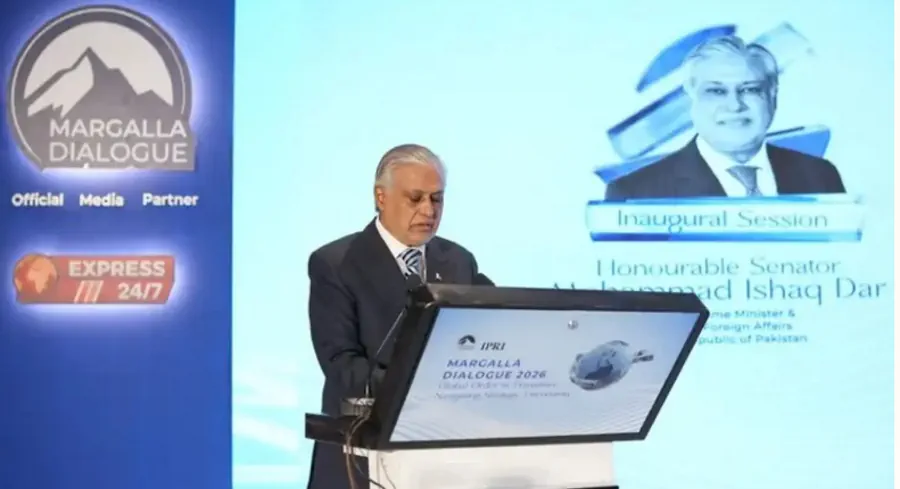
Deputy Prime Minister and Foreign Minister Ishaq Dar has called for a more inclusive and representative international order, warning that growing competition among major powers, regional conflicts and rapid technological developments are creating unprecedented challenges for global stability.
Speaking at the opening session of the seventh Margalla Dialogue in Islamabad on Tuesday, Dar said Pakistan supported a multipolar world in which countries could participate more meaningfully in international decision-making, rather than having global affairs dominated by a limited number of powerful states.
Also Read:
He stressed that cooperation between nations, respect for internationally agreed principles and stronger multilateral institutions were essential to managing an increasingly unpredictable geopolitical environment.
According to the foreign minister, the global balance of power is undergoing significant changes as political competition becomes increasingly connected with economic interests, technological advancement and national security.
Dar identified domestic economic strength and active international engagement as two essential elements of Pakistan’s response to these developments.
“The answer lies in strength at home and effective diplomacy abroad,” he said, emphasizing the importance of economic resilience alongside a proactive foreign policy.
He warned that the international security system was coming under growing pressure as strategic competition intensified and longstanding arms control arrangements weakened.
Political divisions among major powers were also affecting the effectiveness of international organizations, particularly the United Nations, which he said faced increasing difficulties in addressing conflicts and maintaining international peace.
Dar maintained that a multipolar international system could provide smaller and developing countries with greater opportunities to influence global decisions. However, he stressed that such a system would only be effective if supported by meaningful multilateral cooperation and consistent respect for international law.
The foreign minister also drew attention to the security implications of emerging technologies, including artificial intelligence, biotechnology and advanced cyber capabilities.
He said these developments were creating substantial opportunities for economic growth and innovation while simultaneously introducing new risks that existing international institutions were struggling to regulate.
Referring to the humanitarian and security situation in Gaza, Dar expressed concern over the growing tendency of powerful states to rely on force rather than established international principles.
He warned that the concept of “might is right” was becoming increasingly visible in global affairs, threatening the foundations of a rules-based international system.
Dar highlighted Pakistan’s role during its 2025–2026 term as a non-permanent member of the United Nations Security Council, saying Islamabad had consistently supported dialogue, diplomacy and the peaceful settlement of international disputes.
He also referred to Pakistan’s diplomatic efforts to reduce regional tensions, including its facilitation of discussions between the United States and Iran.
The foreign minister said Pakistan had maintained engagement with several important international and regional partners, including China, Saudi Arabia, Türkiye and Egypt, as part of its efforts to promote stability and cooperation.
Discussing South Asian security, Dar reiterated Pakistan’s commitment to defending its sovereignty and territorial integrity while seeking a peaceful settlement of the longstanding Jammu and Kashmir dispute.
He emphasized that Pakistan would continue pursuing diplomatic solutions to regional disagreements while protecting its national interests.
Economic diplomacy also featured prominently in his address, with Dar identifying stronger domestic economic foundations as a necessary condition for Pakistan to navigate changing international power dynamics.
He said improving economic resilience and expanding international economic partnerships would strengthen the country’s ability to respond to geopolitical uncertainty.
Earlier, Islamabad Policy Research Institute (IPRI) President Lieutenant General (retd) Majid Ehsan welcomed participants to the seventh Margalla Dialogue and outlined the challenges confronting the international system.
He said the global order was experiencing growing pressure from unilateral policies, intensifying geopolitical competition and ongoing conflicts across multiple regions.
Ehsan noted that the Margalla Dialogue, established in 2019, had developed into an international forum bringing together policymakers, academics, researchers and strategic affairs experts to examine major global, regional and domestic developments.
Describing the rapidly changing geopolitical environment, he compared the international system to a game of Tetris, in which countries must respond to increasingly complex strategic choices within shrinking timeframes.
“On the global geostrategic Tetris board, the pieces containing geopolitical choices are falling faster while time and space is running out,” he said.
Ehsan presented three possible directions for the future international order.
The first involved the emergence of competing spheres of influence dominated by the United States and China, potentially forcing other countries to make difficult strategic choices between the two powers.
The second scenario envisioned renewed cooperation between Washington and Beijing, allowing the world’s two major powers to manage their differences through engagement and coordinated action.
The third possibility involved a more complex international arrangement combining elements of bipolarity and multipolarity.
Under such a system, countries could develop separate partnerships in areas including infrastructure, technology, energy and defence without necessarily aligning themselves exclusively with either the United States or China.
Ehsan also raised concerns about the weakening of international institutions and legal frameworks established following the Second World War.
He referred to the United Nations Charter, the Geneva Conventions and other international legal arrangements, warning that unilateral actions and growing disregard for established rules were placing these frameworks under considerable strain.
Highlighting ongoing international crises, he cited conflicts involving Gaza, Iran, Ukraine and Afghanistan, alongside instability in several African countries, as examples of the international system’s difficulties in maintaining peace and security.
He said Russia’s continuing war in Ukraine had significantly affected Europe’s security environment while creating broader consequences for energy markets and economic stability.
Similarly, he warned that the conflict involving Iran, the United States and Israel posed serious risks to international energy supplies, global inflation and supply chains.
The two-day Margalla Dialogue is being held under the theme “Global Order in Transition: Navigating Strategic Uncertainty.”
The event brings together experts and policymakers for discussions on the redistribution of global power, competition and connectivity between South and West Asia, technological transformation, national resilience and emerging non-traditional security threats.
The programme also examines how countries can adapt their diplomatic, economic and security strategies as traditional international alliances and institutions face mounting pressure from geopolitical realignment.