Pakistan’s Fiscal Deficit Falls to 2.6%, Lowest in Two Decades: Ahsan Iqbal
- Fiscal deficit narrowed to 2.6% of GDP in FY2025-26 from 5.4% a year earlier.
- Goods exports rose 9.4% to $3 billion in July 2026, while remittances increased 13% to $3.6 billion.
- Large-Scale Manufacturing recorded 5% average growth in FY2025-26, with 16 of 22 sectors showing growth.
- Ahsan Iqbal says the government’s next priority is turning economic stability into sustainable growth under URAAN Pakistan.
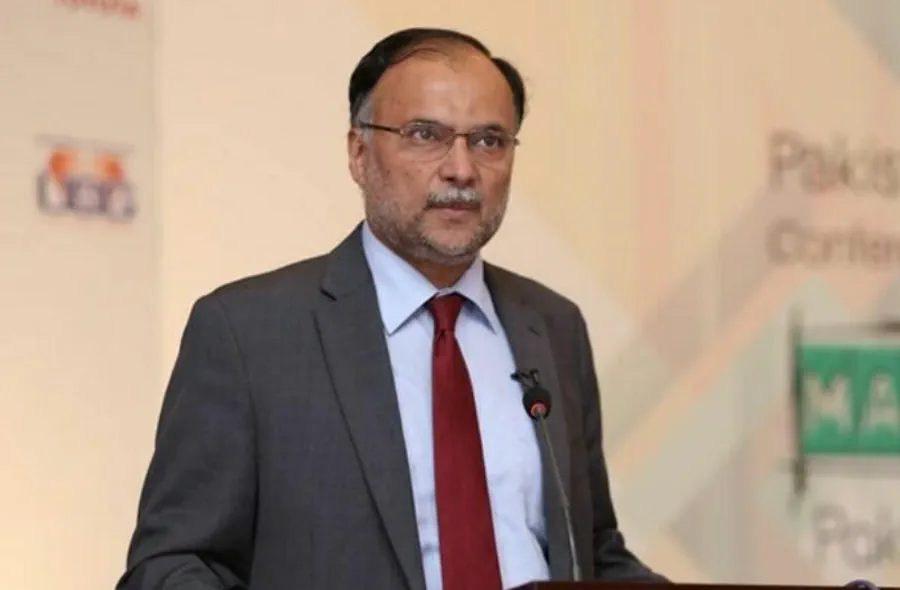
Federal Minister for Planning, Development and Special Initiatives Ahsan Iqbal has said Pakistan is moving from economic stabilization towards economic transformation, pointing to improvements in the fiscal deficit, exports, remittances and industrial activity.
Presenting the Monthly Development Update for August, the minister said Pakistan had passed through a difficult period of economic adjustment and the stability achieved over the past few years had been hard-earned. He said the government’s next priority under URAAN Pakistan was to turn that stability into sustainable economic transformation, with exports playing a key role in creating jobs, raising incomes and expanding opportunities for young people.
Also Read:
According to the update, Pakistan’s fiscal deficit narrowed to 2.6% of GDP in FY2025-26 from 5.4% in FY2024-25. Ahsan Iqbal described it as the country’s lowest fiscal deficit in two decades.
Federal Board of Revenue tax collection also increased to Rs820.9 billion in July FY2026-27, up 8.4% from Rs757.4 billion in the corresponding month of the previous year.
The minister said the start of FY2026-27 had produced encouraging economic signals. Consumer Price Index inflation stood at 9.2% in July 2026, compared with 11.7% in May. He said the year-on-year increase from 4.1% largely reflected the base effect and the impact of global food and energy prices.
The government, he added, was continuing to monitor prices through regular meetings of the National Price Monitoring Committee, with attention being given to supply chains, the quality of essential commodities and administrative measures aimed at keeping essential goods affordable.
Workers’ remittances reached $3.6 billion in July 2026, representing a 13% increase from $3.2 billion in July 2025. The latest figures followed record remittances of $41.6 billion during the previous fiscal year.
Industrial activity also improved, with Large-Scale Manufacturing recording average growth of 5% in FY2025-26 compared with a contraction of 0.7% in the previous year. Sixteen of the 22 sectors covered recorded positive growth.
Automobile production posted the strongest increase at 57.8%, followed by transport equipment at 42.4%, electrical equipment at 14.3%, tobacco at 12.6% and food at 7%.
Exports also recorded growth at the beginning of the new fiscal year. Goods exports increased by 9.4% to $3 billion in July 2026 from $2.8 billion in July 2025. Total exports of goods and services rose 13% to $3.9 billion from $3.5 billion.
Among major export groups, surgical goods increased by 16.3%, food exports by 8%, leather goods by 7.8% and textiles by 3.9%. Information and Communication Technology exports reached $417 million in July, further contributing to the country’s external earnings.
Imports of goods and services increased 13% to $7.3 billion in July 2026 from $6.5 billion a year earlier. Despite higher imports, the current account deficit stood at $328 million, compared with $529 million in July 2025.
On development spending, Ahsan Iqbal said resources were being directed towards projects expected to generate stronger economic and social returns. Under the Finance Division’s release strategy, the Planning Ministry authorized Rs211.327 billion, equivalent to 21.1%, during July 2026 for priority development projects.
During July FY2026-27, the Central Development Working Party considered 27 agenda items, including 22 projects, four position papers and one concept clearance proposal. Nine projects, three position papers and one concept clearance proposal were approved, while nine projects were recommended to the Executive Committee of the National Economic Council.
Three projects were deferred, while one project and one position paper were returned to their sponsors for further consideration.
Projects approved during July are expected to create around 7,851 direct and 14,053 indirect jobs across different sectors. A review of CDWP projects also resulted in savings of Rs1.02 billion after non-essential components were streamlined. Five PSDP projects were monitored and two were evaluated during the month.
Ahsan Iqbal said investment in human capital remained an important part of the government’s economic strategy. With Pakistan’s population at 254.6 million, the government has emphasized investment in health, education, skills and women’s empowerment to improve the country’s ability to benefit from its young population.
The National Logistic Board also reviewed the operational and financial performance of the National Logistics Corporation on July 28, along with regional connectivity initiatives. Discussions included transit trade hubs, border and logistics infrastructure, reducing trade costs and strengthening Pakistan’s role as a regional trade and connectivity hub.
The Planning Ministry on July 29 also launched the 50th issue of Development Advocate Pakistan, titled “A Nation at a Turning Point.” The publication noted that 67% of Pakistan’s population is below the age of 30 and highlighted policy continuity, evidence-based planning and human capital development, including an initiative to train one million young people as “Ambassadors of Social Change” under URAAN Pakistan.
Ahsan Iqbal said the economic indicators at the start of FY2026-27 were encouraging, but maintaining progress would require fiscal discipline, stronger exports, productive investment, institutional reforms and continued investment in human capital.