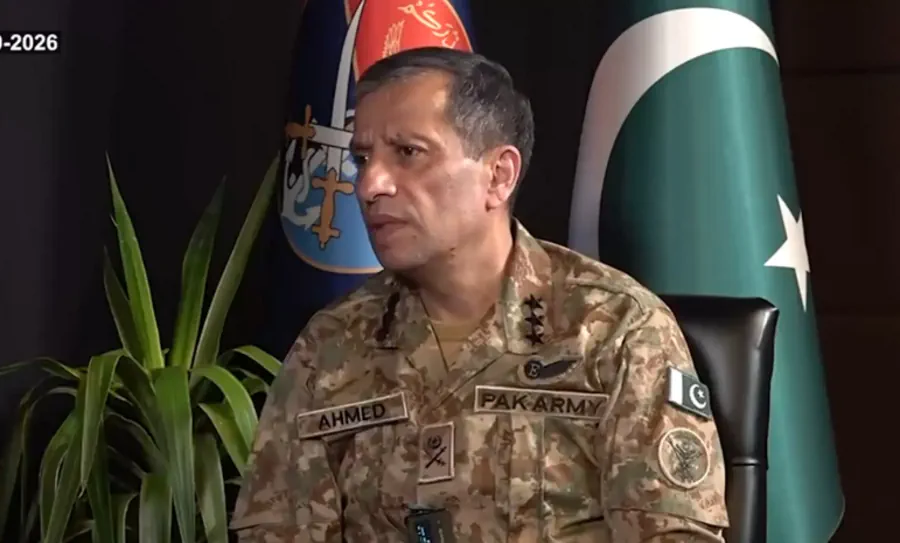
Pakistan Accuses India of Backing Terrorist Groups Operating From Afghanistan
- DG ISPR Lieutenant General Ahmed Sharif Chaudhry accuses India of supporting militant organisations operating from Afghan territory.
- Pakistan alleges that the Afghan Taliban authorities are allowing terrorist groups, including the TTP and BLA, to carry out attacks against Pakistan.
- Military spokesperson warns of consequences for cross-border terrorism and says Pakistan is prepared to counter emerging drone and cyber threats.
Inter-Services Public Relations (ISPR) Director General Lieutenant General Ahmed Sharif Chaudhry has accused India of financing and supporting terrorist organisations operating from Afghanistan, alleging that the Afghan Taliban administration is acting as a proxy in activities targeting Pakistan.
Speaking in an interview with Reuters earlier this week, the military spokesperson said several militant organisations were operating from Afghan territory and receiving external support, posing serious security challenges for Pakistan and the wider region.
Also Read:
He specifically identified the Tehreek-e-Taliban Pakistan (TTP) and Balochistan Liberation Army (BLA) as organisations allegedly being used by India to carry out terrorist activities against Pakistan.
The DG ISPR also highlighted the presence of several other militant organisations in Afghanistan, including Al-Qaeda, Islamic State Khorasan Province (ISKP), East Turkestan Islamic Movement (ETIM) and Islamic Movement of Uzbekistan (IMU).
According to Lieutenant General Chaudhry, Afghanistan has become a base for multiple armed groups and foreign-backed organisations following decades of international interventions and political instability.
He described the Afghan Taliban administration as a non-state actor exercising control over the country and questioned its credibility in addressing regional security concerns.
The military spokesperson rejected allegations that Pakistan was supporting former Afghan government officials, military personnel or other groups opposing the Taliban administration.
He maintained that the presence of militant organisations in Afghanistan was not merely Pakistan’s assessment, saying United Nations reports and intelligence findings from the United States and other countries had also documented the activities of such groups.
Addressing concerns that diplomatic and economic isolation could further worsen Afghanistan’s humanitarian situation, Lieutenant General Chaudhry clarified that Pakistan was not seeking to isolate its neighbouring country.
Instead, he said Islamabad wanted the Afghan Taliban authorities to fulfil the responsibilities of a government and prevent their territory from being used for terrorist activities.
He urged the Afghan administration to end support for militancy and drug production, describing terrorism and narcotics as two major threats originating from Afghanistan that affected regional and international security.
The DG ISPR said Pakistan continued to engage with the Afghan authorities and had repeatedly demanded action against militant leaders allegedly operating from their territory.
He named TTP chief Noor Wali Mehsud, BLA commander Bashir Zeb and militant leader Gul Bahadur among individuals whom Pakistan believed were present in Afghanistan.
According to the military spokesperson, militant groups were receiving weapons, logistical assistance and operational support from Afghan territory to conduct attacks inside Pakistan.
Warning against continued cross-border militancy, he said Pakistan possessed both the strategy and military capability to respond to threats originating from Afghanistan.
“If they do it, then there will be a cost,” Chaudhry warned, indicating that Pakistan was prepared to take necessary measures to protect its security interests.
The interview also addressed the growing use of drones and other advanced technologies in modern warfare, particularly their increasing availability to non-state armed groups.
Lieutenant General Chaudhry said military operations had evolved significantly, with conventional warfare now accompanied by cyber operations, artificial intelligence and non-contact combat capabilities.
He expressed concern over the growing accessibility of drone technology to armed organisations, including the Afghan Taliban and Yemen’s Houthi movement, saying such developments required countries to review and strengthen their defence systems.
When asked whether Pakistan considered the Afghan Taliban’s drone capabilities a significant threat, the DG ISPR said Afghanistan lacked an independent drone manufacturing industry and the technological infrastructure required to develop such systems.
He alleged that the equipment available to the Afghan Taliban was being supplied by external sponsors, again accusing India of providing support.
Chaudhry maintained that Pakistan’s armed forces had already demonstrated their ability to counter sophisticated drone threats during previous military confrontations with India.
He said the military had strengthened its operational preparedness and possessed the necessary capabilities to respond effectively to potential drone attacks.
Discussing technological developments within Pakistan’s armed forces, the DG ISPR said the military was continuously adopting advanced systems to meet the changing requirements of modern warfare.
He confirmed that artificial intelligence, cyber capabilities and other emerging technologies were becoming increasingly important components of military operations.
However, he declined to disclose operational details concerning the military’s use of artificial intelligence, quantum technology and cyber warfare systems.
“We are using all sorts of technologies. We are a technology-savvy army,” Lieutenant General Chaudhry said, emphasising the armed forces’ focus on technological advancement and operational readiness.