Pakistan Eyes Saudi, Kuwaiti and Qatari Oil Reserves Under New Storage Plan
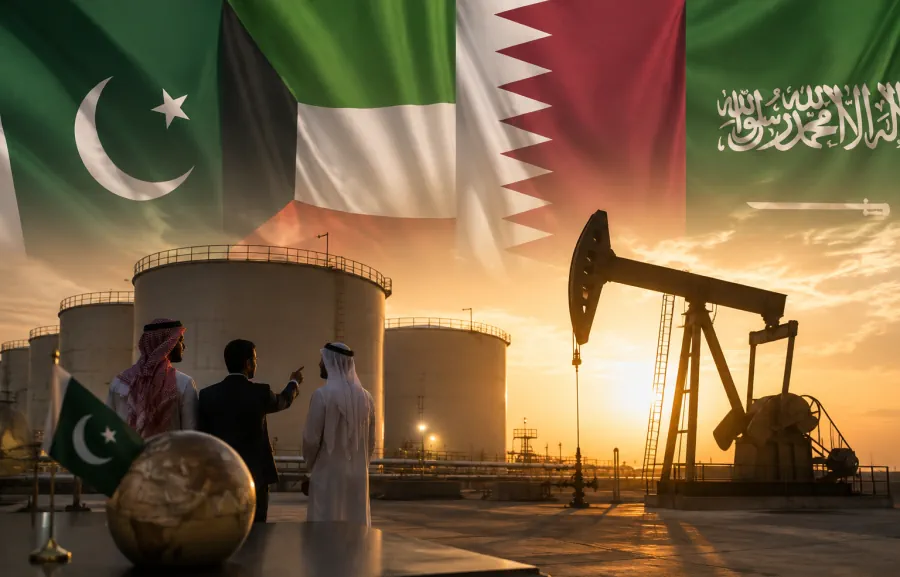
- Saudi Arabia, Kuwait and Qatar could store crude oil and petroleum products in Pakistan under a proposed bonded arrangement.
- Foreign partners would bear the storage costs, while Pakistan could purchase the reserves during an emergency.
- The proposal has been sent to the Economic Coordination Committee, with a decision expected next week.
- Pakistan currently imports around 90% of its energy requirements, increasing its exposure to disruptions in global oil markets.
Pakistan is moving to establish a new oil-storage arrangement with Saudi Arabia, Kuwait and Qatar aimed at building an additional layer of energy security without requiring heavy upfront government spending.
Petroleum Minister Ali Pervaiz Malik said the proposed commercial bonded scheme would allow the three Gulf countries to keep crude oil and petroleum products at secure facilities inside Pakistan at their own expense. The stored supplies could subsequently be sold to international buyers.
Also Read:
The arrangement would give Pakistan an important safeguard during a major international supply disruption. Malik said that if a conflict or similar emergency affected normal oil supplies, Pakistan would have the option to pay for and purchase the petroleum stocks already stored within the country to meet domestic demand.
Speaking at a press conference in Lahore on Sunday, the minister said the framework had been developed with assistance from Saudi Aramco and other major industry players.
On the instructions of Prime Minister Shehbaz Sharif, the proposal has now been submitted to the Economic Coordination Committee for consideration. Malik said a decision was expected as early as next week.
The initiative is intended to address one of Pakistan’s key energy vulnerabilities: its heavy dependence on imported fuel. According to Malik, approximately 90% of the country’s energy requirements are met through imports.
Pakistan currently produces about 70,000 barrels of crude oil per day domestically, compared with overall demand of roughly 500,000 barrels per day. Malik said increasing local oil and gas exploration was therefore essential to gradually reduce reliance on foreign supplies.
Building substantial strategic reserves independently would require considerable investment. The minister estimated that maintaining enough crude oil for one month would require approximately $500 million, while developing underground storage infrastructure could cost another $300 million to $400 million.
He said the government could examine such an investment at a later stage, while the bonded-storage model offered a way to improve supply security without immediately committing such large amounts of public money.
The proposal comes as disruptions in international energy markets have renewed concerns over the security and cost of Pakistan’s fuel imports. Malik said the recent US-Iran conflict had disrupted oil movement through the Strait of Hormuz and resulted in unusually sharp increases in international crude and petroleum product prices.
Despite the pressure on global markets, the minister said fuel supplies had remained uninterrupted across Pakistan and the government had sought to limit the impact of international price increases on consumers.
Malik also outlined plans to increase domestic energy production. He announced that Turkish Petroleum of Turkiye was preparing to begin offshore drilling in Pakistan’s territorial waters, a development the government expects could encourage foreign investment and potentially add to domestic energy resources.
A broader strategy for the sector is also being developed. Malik said Prime Minister Shehbaz Sharif and Chief of Defence Forces and Chief of Army Staff Field Marshal Syed Asim Munir had assigned a leading international company to prepare a comprehensive roadmap for Pakistan’s energy sector. The plan is expected to be presented to the country’s leadership in the coming months.
On domestic petroleum-sector reforms, Malik said the government had stopped further accumulation of circular debt and was working to settle outstanding liabilities inherited from previous governments.
He also announced that LPG tenders would open on Monday and said arrangements had been completed to provide new gas connections to consumers.
Addressing petroleum prices, the minister said the government remained focused on providing consumers with as much relief as its financial position allowed. He said Prime Minister Shehbaz Sharif had introduced a transparent mechanism for determining petroleum prices, with the relevant calculations made available through the Oil and Gas Regulatory Authority.
Malik also pointed to the federal cabinet’s approval of a new refinery policy last month, describing it as part of efforts to address structural problems that have affected Pakistan’s petroleum industry for years.
Turning to the wider economic outlook, Malik said sustainable economic growth was now a major national priority following Pakistan’s recent strategic and diplomatic developments. He described the Makkah defence agreement as a source of national pride and said Pakistan had emerged as a net security provider in the region.
He added that closer cooperation combining Saudi Arabia’s economic strength, Turkiye’s technological capabilities and Pakistan’s defence capacity could support greater regional stability as well as deeper economic collaboration.