Nvidia Unveils New AI PC Chip, Aims To Bring AI Agents Directly To Computers
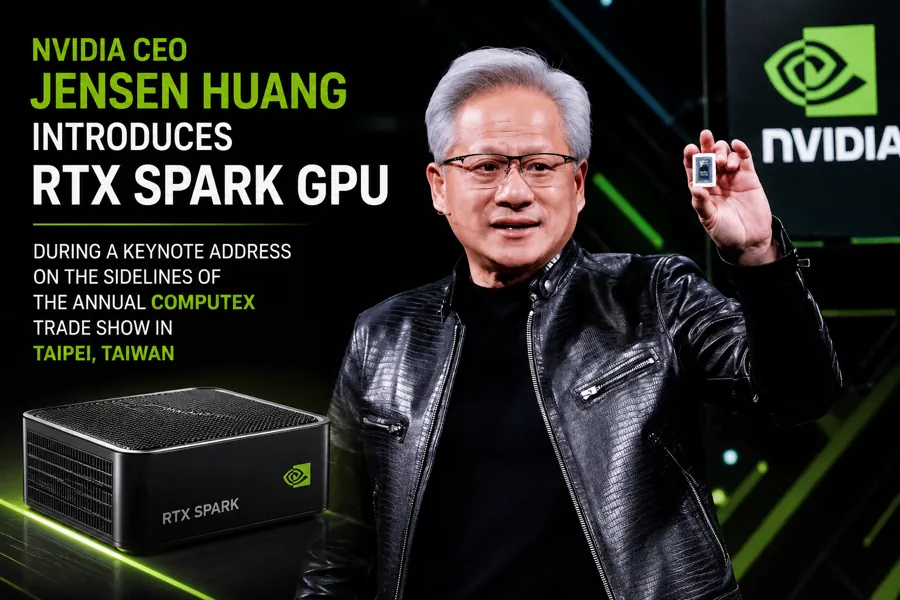
NVIDIA has introduced a new personal computer chip designed to run artificial intelligence directly on laptops and desktop computers, marking a major step toward making AI-powered computing more accessible to everyday users.
Speaking ahead of the Computex technology exhibition in Taiwan, NVIDIA Chief Executive Officer Jensen Huang announced the new RTX Spark PC chip, describing it as a key part of the company’s collaboration with Microsoft to reshape the future of personal computing for the AI era.
Also Read:
According to Huang, the RTX Spark chip has been developed to run AI agents locally on devices instead of relying entirely on cloud-based processing. The project was created in partnership with Taiwanese semiconductor company MediaTek and is expected to reach consumers later this year.
Industry analysts believe the launch could significantly change how people interact with artificial intelligence. Neil Shah, co-founder of Counterpoint Research, said the technology could shift computers away from traditional application-based usage and toward intelligent AI-driven systems capable of performing tasks independently.
He suggested that AI-powered personal computers could eventually become a standard feature in households worldwide as private AI agents become increasingly important for productivity, communication and everyday digital activities.
The announcement also highlighted NVIDIA’s growing ambitions beyond graphics processors. Huang devoted considerable attention to the company’s new Vera central processing unit (CPU), which has been specifically designed to support AI agents and advanced computing workloads.
According to NVIDIA, organizations including OpenAI, Anthropic and SpaceX are among the early adopters of the Vera CPU. Huang previously stated that the new processor family opens access to a market worth an estimated $200 billion and could become one of the company’s major growth drivers in the coming years.
During his presentation, Huang rejected concerns that artificial intelligence will reduce employment opportunities for software engineers. Instead, he argued that AI tools increase productivity and create demand for more skilled workers.
“The number of software engineers is actually increasing,” Huang said, dismissing fears that AI will replace programmers. He maintained that AI technologies are helping organizations expand development efforts rather than shrink them.
Huang also emphasized Taiwan’s critical role in the global technology supply chain and AI ecosystem. Born in Taiwan’s southern city of Tainan, he recently announced plans to invest approximately $150 billion annually in Taiwan, describing the island as a central hub of the global AI revolution.
The announcement comes as technology leaders from around the world gather in Taipei for Computex 2026, one of the largest technology trade shows globally. The event runs from June 2 to June 5 and is expected to showcase the latest developments in artificial intelligence, semiconductors, computing and consumer technology.