Peace Is Pakistan’s Choice, but Aggression Will Face Strong Response: PM Shehbaz
- PM Shehbaz says Pakistan seeks peace with dignity but will firmly defend its sovereignty.
- Warns any future aggression could face a stronger response than the May 2025 confrontation.
- Says Pakistan will not compromise on its water rights following India’s move on the Indus Waters Treaty.
- Calls for national unity while reaffirming Pakistan’s positions on Kashmir, Palestine and Afghanistan.
Prime Minister Shehbaz Sharif has said Pakistan remains committed to peace and regional stability, but warned that the country is fully prepared to defend its sovereignty if confronted with aggression.
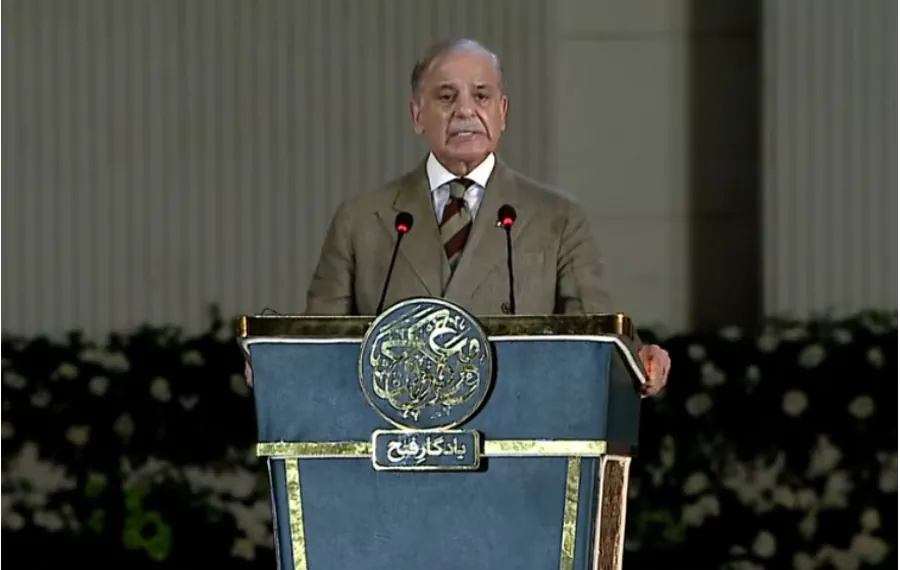
Speaking at an Independence Day ceremony on Thursday, Shehbaz said Pakistan’s preference for peaceful relations should not be interpreted as an inability or unwillingness to respond to threats. Referring to the May 2025 Marka-e-Haq, he said Pakistan had already demonstrated its defensive capabilities and would respond with even greater force if its security was challenged again.
Also Read:
The prime minister made the remarks during celebrations marking Pakistan’s 79th Independence Anniversary, where the Yadgar-e-Fatah, or Victory Monument, was also inaugurated to commemorate the sacrifices of martyrs and Pakistan’s 2025 military success.
A significant part of Shehbaz’s address focused on water security. He criticised India’s unilateral suspension of the Indus Waters Treaty following last year’s confrontation and described the move as illegal and damaging to regional peace.
Declaring Pakistan’s water rights non-negotiable, the prime minister said “every single drop” of the country’s water represented a red line. He warned that Pakistan would respond appropriately if India continued actions threatening those rights.
Shehbaz also used the occasion to reaffirm Islamabad’s longstanding position on Kashmir, saying Pakistan would continue providing political, diplomatic and moral support to Kashmiris in their pursuit of the right to self-determination. He said their sacrifices would not be allowed to go in vain.
Pakistan’s support for a just settlement of the Palestinian issue was also reiterated during the address.
On Afghanistan, the prime minister struck a similar balance between cooperation and security concerns. He said Pakistan wanted a peaceful and stable Afghanistan, but stressed that Afghan territory must not be allowed to serve as a base for terrorist attacks against Pakistan.
Shehbaz urged the Afghan leadership to prevent militant groups from finding sanctuary on its soil, saying the neighbouring countries had a shared interest in stability but Pakistan could not accept cross-border terrorism.
The prime minister also highlighted what he described as Pakistan’s growing diplomatic role, referring to its mediation efforts between the United States and Iran and the defence arrangement involving Saudi Arabia, which he said Turkiye had also joined.
He described the Makkah Agreement as an initiative carrying hopes for peace not only in the Middle East and the Muslim world but also for the wider international community.
Discussing relations with major international partners, Shehbaz praised Pakistan’s close ties with China and said relations with the United States were improving. He also credited US President Donald Trump with playing an effective role in helping secure the Pakistan-India ceasefire last year.
The newly inaugurated Yadgar-e-Fatah, meanwhile, was presented by the prime minister as a reminder of both military sacrifice and national solidarity. He said the monument represented the courage of those who lost their lives defending Pakistan, the bravery of veterans and the unity demonstrated by the public during the 2025 confrontation.
Shehbaz paid tribute to Field Marshal Syed Asim Munir for his leadership during Marka-e-Haq and acknowledged the role of the Pakistan Air Force under Air Chief Marshal Zaheer Ahmed Babar Sidhu and the Pakistan Navy under Admiral Naveed Ashraf.
He also praised the engineers, labourers and other personnel involved in constructing the monument, which he said was completed within eight months.
President Asif Ali Zardari joined the prime minister for the inauguration. The ceremony was attended by senior state and military leadership, including Senate Chairman Syed Yousuf Raza Gilani, National Assembly Speaker Sardar Ayaz Sadiq, Deputy Prime Minister Ishaq Dar, Chief Justice of Pakistan Justice Yahya Afridi, Field Marshal Syed Asim Munir, Air Chief Marshal Zaheer Ahmed Babar Sidhu and Admiral Naveed Ashraf. Federal ministers, parliamentarians, diplomats, provincial political leaders and armed forces officers were also present.
Beyond defence and foreign policy, Shehbaz called on young Pakistanis to prepare themselves for a rapidly changing global economy by developing expertise in information technology, artificial intelligence and other modern sciences. He said the government would provide available resources to help young people acquire such skills.
The prime minister concluded by linking Pakistan’s future progress to greater internal unity. He urged citizens to move beyond political and social divisions and recreate the sense of national solidarity witnessed during Marka-e-Haq.
While recognising disagreement as a legitimate part of society, Shehbaz cautioned that allowing differences to develop into hostility ultimately weakened the country. Pakistan, he said, belonged equally to its citizens, who shared responsibility for its stability, development and prosperity.