Pakistan Targets $100 Billion Exports, Ahsan Iqbal Calls for Private Sector-Led CPEC Phase-II
- Planning Minister Ahsan Iqbal says the private sector must take a leading role in unlocking the economic potential of CPEC Phase-II.
- He says CPEC Phase-I attracted around $25 billion in Chinese investment and added nearly 8,000MW to Pakistan’s power generation capacity.
- The government aims to increase Pakistan’s exports to $100 billion by 2035, describing export growth as a “national emergency”.
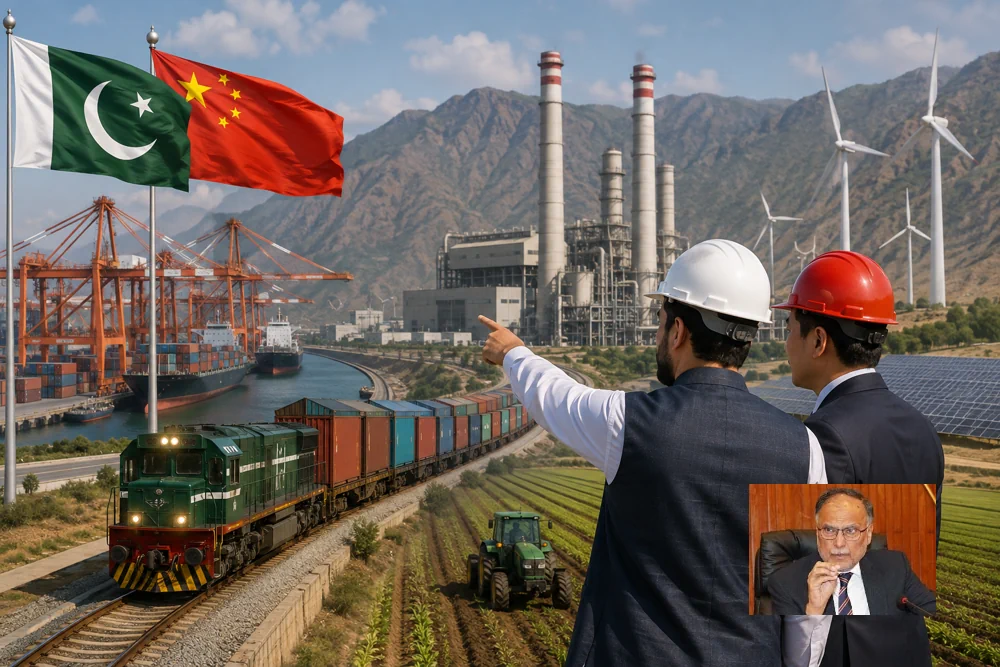
Federal Minister for Planning, Development and Special Initiatives Ahsan Iqbal has called for a stronger private-sector role in the second phase of the China-Pakistan Economic Corridor (CPEC), saying business partnerships, industrial development and exports will be central to Pakistan’s next stage of economic growth.
The minister made the remarks while chairing a detailed review meeting in Islamabad on September 1 to assess progress on the CPEC Action Plan for 2025–2029. The plan was finalised during Prime Minister Muhammad Shehbaz Sharif’s visit to China in August 2025.
Also Read:
Officials reviewed progress made during the first year of the action plan and discussed measures to speed up implementation of the priorities agreed between Pakistan and China.
Ahsan Iqbal said Pakistan-China relations had continued to strengthen during difficult periods, recalling China’s investment in Pakistan at a time when the country was facing severe electricity shortages.
According to the minister, the first phase of CPEC brought around $25 billion in Chinese investment and contributed nearly 8,000 megawatts to Pakistan’s electricity generation capacity. He said these projects played an important role in addressing the energy crisis and improving the country’s energy security.
He also identified the development of Thar coal and the fibre-optic network as major achievements under the first phase. CPEC Phase-II, he said, would move further towards business-to-business cooperation, industrialisation, modern agriculture, minerals, technology and human capital development.
The planning minister said the new phase of CPEC was closely connected with the five pillars of the government’s URAAN Pakistan programme through five corridors covering Growth, Livelihood, Innovation, Green Economy and Openness.
Under the Growth Corridor, the government intends to strengthen Pakistan’s industrial and agricultural capacity with a focus on increasing exports. The Livelihood Corridor will concentrate on social development and improving opportunities in less-developed parts of the country.
Ahsan Iqbal said the Innovation Corridor, linked with the E-Pakistan initiative, would focus on improving the country’s information technology capabilities and providing millions of young Pakistanis with modern technological skills.
“Our young population is Pakistan’s greatest economic asset,” he said, stressing the importance of preparing young people for emerging opportunities in technology and the modern economy.
The Green Economy Corridor, meanwhile, will focus on climate resilience, agricultural modernisation, water security and food security.
Discussing agricultural reforms, Ahsan Iqbal highlighted the government’s initiative to send 1,000 Pakistani agricultural experts to China for training in modern farming technologies.
He said the programme was intended to develop a sizeable pool of trained professionals who could help modernise Pakistan’s agriculture sector. The initiative is expected to contribute towards what the government describes as “Green Revolution 2.0”, involving better seeds, increased farm mechanisation, more efficient use of water and greater adoption of climate-resilient crops.
Ahsan Iqbal said the government alone could not realise the full economic potential of CPEC Phase-II and stressed that the private sector should take the lead in investment and commercial partnerships, while the state provides an enabling environment for businesses.
He described increasing exports as a “national emergency” and said Pakistan must work towards achieving $100 billion in exports by 2035, a target he termed essential for the country’s economic survival.
The minister called for closer cooperation between the government and private sector to improve Pakistan’s competitiveness in international markets and establish “Made in Pakistan” as a globally recognised brand. He also directed relevant ministries to ensure timely implementation of projects and commitments included in the CPEC Phase-II action plan.
Ahsan Iqbal also linked the success of Pakistan’s economic transformation to political stability, warning that the country could not afford continued instability while attempting to achieve long-term development goals.
He said Pakistan’s recent strategic and diplomatic successes needed to be converted into tangible economic gains through reforms, improved governance and national unity.
“For Pakistan’s future and a better tomorrow for our youth, we cannot compromise on the country’s economic development,” he said.
Calling on political forces to prioritise economic progress, Ahsan Iqbal added: “Pakistan does not need to heat its roads; Pakistan needs to heat its economy.”
He urged political stakeholders to focus their efforts on strengthening the economy and helping Pakistan become a more self-reliant, competitive and export-driven country.