Ballistic Missile Intercepted Over Riyadh as Fire Erupts Near King Khalid Airport
- Saudi air defences intercepted a ballistic missile launched towards Riyadh at dawn.
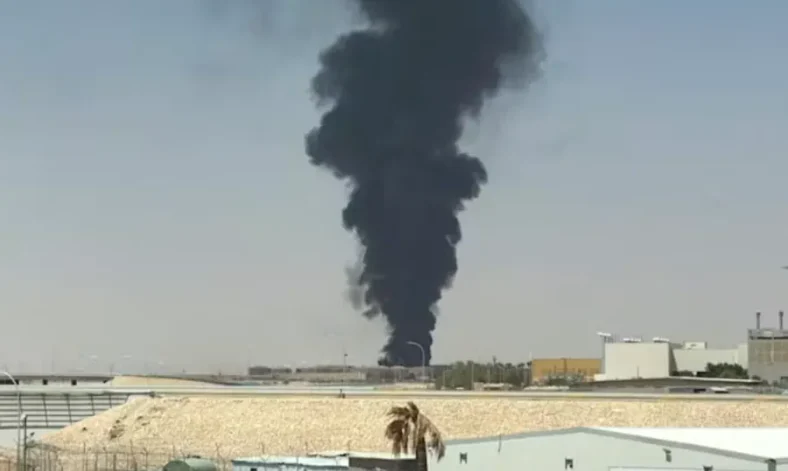
- A fire broke out at an Aramco-branded fuel facility near King Khalid International Airport.
- Houthi forces claimed missile and drone operations targeting Riyadh and Aramco facilities in Yanbu.
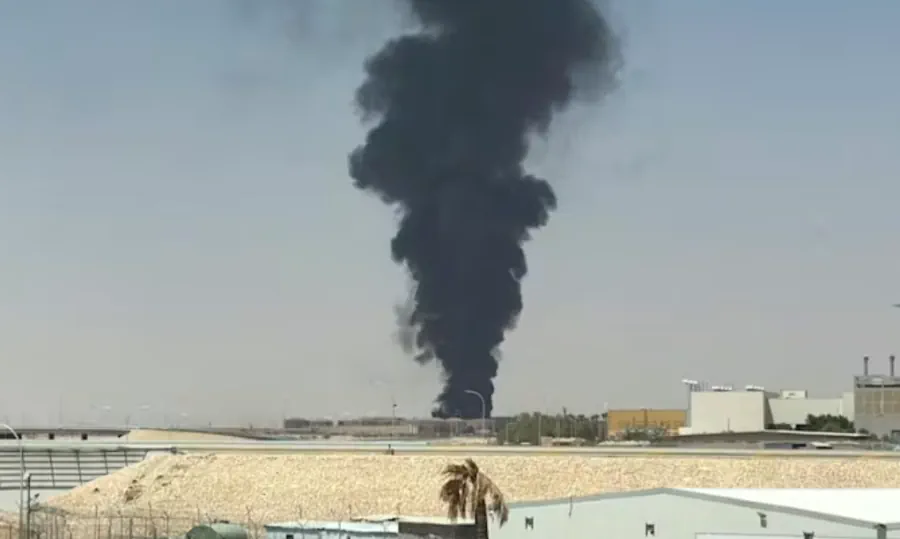
RIYADH: Saudi Arabia’s air defences intercepted and destroyed a ballistic missile launched towards Riyadh early Saturday, as firefighters battled a blaze at a fuel depot near King Khalid International Airport.
A fuel tank carrying the logo of Saudi oil company Aramco caught fire at the facility near the airport. Videos circulating online showed thick black smoke rising above buildings in the surrounding area. The blaze was later extinguished.
Also Read:
Saudi-led coalition spokesman Turki al-Malki said the missile was fired by Yemen’s Iran-backed Houthi movement and was successfully destroyed before reaching its intended target.
According to Al-Malki, additional attempts were made to target civilians and civilian infrastructure in Bisha, Taif, Farasan and Yanbu. He said Saudi air-defence systems thwarted the attacks.
The Houthis later claimed responsibility for two military operations involving ballistic missiles, cruise missiles and drones. Houthi military spokesman Yahya Saree said one operation targeted sensitive locations in Riyadh, while the second struck Aramco facilities in Yanbu.
Saudi authorities issued an air-raid warning shortly before 3am, advising Riyadh residents to remain indoors because of what was described as a hostile aerial threat. The alert was lifted approximately 30 minutes later.
Residents in different parts of the capital reported hearing several explosions during the early hours. One resident in northern Riyadh said the warning was followed by blasts that caused windows to shake, while another described the situation as terrifying.
Flight-tracking service FlightRadar24 reported significant disruption at King Khalid International Airport and temporarily placed it at the highest level of its disruption index. Flight operations later began returning to normal.
The US State Department and American diplomatic missions across the region also issued a security warning, saying the conflict had the potential to escalate rapidly. The alert noted that Iranian-backed Houthi forces had previously targeted Saudi Arabia, including civilian airports.
The attack marked the first time since the latest phase of Yemen’s civil war began that strikes had directly threatened Riyadh. It came amid an intensified Houthi offensive that has captured significant territory and placed additional pressure on Yemen’s internationally recognised government, which is supported by Saudi Arabia.
Saudi forces have responded with dozens of airstrikes against Houthi-controlled areas, but the military campaign has so far failed to halt the group’s advance.
The Riyadh incident occurred days after Saudi Arabia accused the Houthis of attempting to target Makkah. Saudi authorities condemned the alleged strike as a terrorist attack against Islam’s holiest city, while the Houthis rejected the accusation and described it as false.
Houthi forces have reported daily Saudi retaliatory strikes since launching an operation aimed at taking control of Yemen’s entire Red Sea coastline. Expanded control along the coast would give the group greater influence over the strategically important Bab al-Mandab Strait.
The United States reportedly rejected a recent Saudi request to carry out strikes against Houthi positions. Washington subsequently approved the proposed sale of 48 F-35 fighter jets to Saudi Arabia in a deal valued at $24.3 billion, saying the aircraft would help the kingdom respond to present and future security threats.
Regional analyst Anna Jacobs said Saudi Arabia and the Houthis appeared to be entering a more dangerous stage of confrontation, even though negotiations would ultimately be required to end the conflict. She said both sides remained caught in an escalation cycle and would have to agree on when diplomatic talks could resume.
The renewed fighting has displaced more than 112,000 people, while nearly 3,000 others have crossed the Red Sea to seek safety in Djibouti.
Yemen’s conflict began in 2014 when the Houthis seized the capital, Sanaa, and other parts of the country. Saudi Arabia led a military intervention in March 2015 in support of the internationally recognised government.
A fragile truce reached in 2022 collapsed in July after the Houthis allowed an Iranian aircraft to land in Yemen despite Saudi control over the country’s airspace.
Houthi forces have also been strengthening their defences in newly captured areas along Yemen’s Red Sea coast by installing radar systems and constructing tunnels.