US-Iran Peace Deal Could Deliver $20 Billion Economic Boost To Pakistan: Report
• Pakistan could gain up to $20 billion from a US-Iran peace settlement
• Gwadar, trade, exports and energy sectors among key beneficiaries
• Report highlights major gains from lower oil prices and regional connectivity
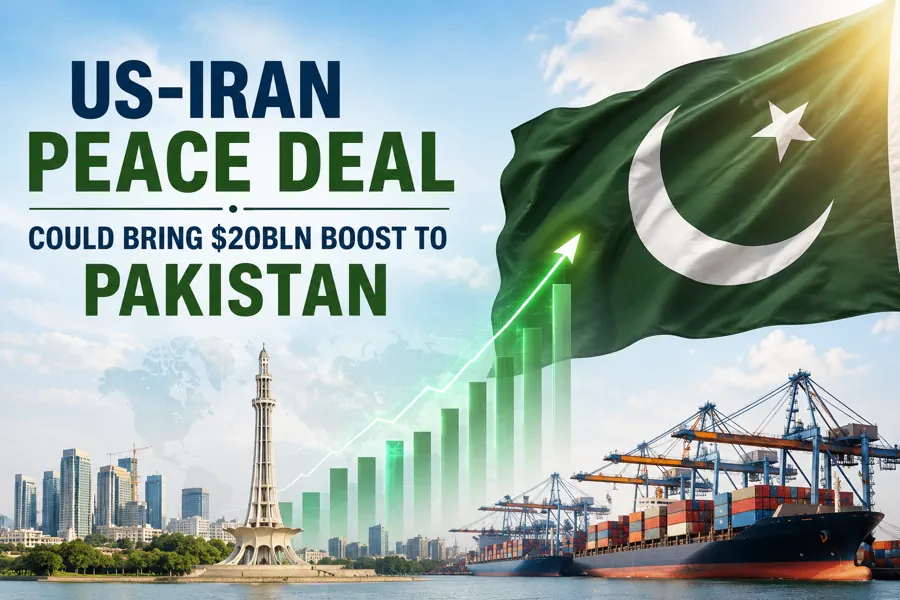
A potential peace agreement between the United States and Iran could generate economic benefits of up to $20 billion for Pakistan, according to a new report released by KTrade Securities.
Also Read:
The report identifies Pakistan as one of the biggest relative beneficiaries among emerging economies if a phased settlement is reached and commercial activity through the Strait of Hormuz returns to normal levels.
Analysts noted that Pakistan’s strategic geographic location could enable it to play a significant role in regional trade and economic realignment, creating opportunities across multiple sectors of the economy.
According to the report, six major channels could drive economic gains for Pakistan. These include an improvement of 75 to 150 basis points in the country’s risk profile, foreign exchange reserves rising above $20 billion, export recovery worth around $4 billion to Gulf Cooperation Council (GCC) markets, lower inflation due to easing oil prices, an annual current account surplus of up to $5 billion and increased labour demand from Saudi Arabia for as many as 800,000 Pakistani workers annually.
The report states that disruptions in the Strait of Hormuz have already imposed a significant economic burden on Pakistan, with estimated losses ranging between $10 billion and $14 billion, equivalent to approximately 2% to 3% of the country’s gross domestic product.
According to analysts, the disruption contributed to higher inflation, which reached 11.7% in May 2026, widened the current account deficit and prompted the State Bank of Pakistan to increase interest rates by 100 basis points in April.
One of the biggest potential beneficiaries identified in the report is Gwadar Port. Due to its location outside the Strait of Hormuz, Gwadar has gained importance as an alternative trade and logistics hub during periods of regional uncertainty.
The report noted that container throughput at Gwadar reached 11,000 TEUs in April 2026, exceeding the total volume handled during the entire previous year. If such activity levels are maintained, the port could generate annual revenues of $50 million to $80 million, excluding additional income from transit trade and special economic zones.
Saudi Arabia is also reported to be investing in oil storage infrastructure at Gwadar. According to the report, Riyadh has already transferred $2 billion to Pakistan and pledged an additional $3 billion for future projects.
Trade between Pakistan and Iran could also see substantial growth if sanctions are eased and a stable trade corridor is established. The report estimates bilateral trade could reach $2 billion in the near term.
Potential Pakistani exports to Iran include cement, textiles, rice, fruits and medical products, while imports could consist of energy products, chemicals, plastics and steel. Analysts also noted that reconstruction activity in Iran could create additional demand for Pakistani cement exports.
Another major opportunity highlighted in the report is the long-discussed Iran-Pakistan gas pipeline project. Pakistan currently imports liquefied natural gas from Qatar at around $13 per MMBtu, while Iranian pipeline gas is estimated to cost between $6 and $8 per MMBtu.
If the project becomes operational, Pakistan could save between $1.5 billion and $2 billion annually in energy costs, according to the report.
KTrade Securities also pointed to the Pakistan-Saudi defence and investment agreement signed in September 2025, estimating its overall economic impact at around $15 billion. The agreement reportedly includes $10 billion in Saudi investments, expanded trade targets and Pakistan’s deployment commitments of 25,000 troops.
The report further highlighted the long-term potential of the China-Pakistan Economic Corridor (CPEC), with total investments projected to reach $62 billion by fiscal year 2030. Analysts suggested that Iran’s eventual inclusion in regional connectivity projects could strengthen trade links between South Asia, Central Asia and Europe.
The report concluded that improved regional stability could also support Pakistan’s stock market and help reduce inflation to between 5% and 7% by late 2026. Lower energy costs and easing inflationary pressures could create room for monetary easing and broader economic stabilization in the years ahead.