Pakistan’s Digital Banking Users Surge to 137 Million as Transactions Hit 11.9 Billion
- Pakistan added 42 million digital banking users within a year, taking the total from 95 million to 137 million.
- Digital transactions jumped from 6.9 billion to 11.9 billion as banks, fintech companies and governments expanded electronic payment services.
- The government is prioritising Raast and wants at least one digital payment option available for every public-sector transaction.
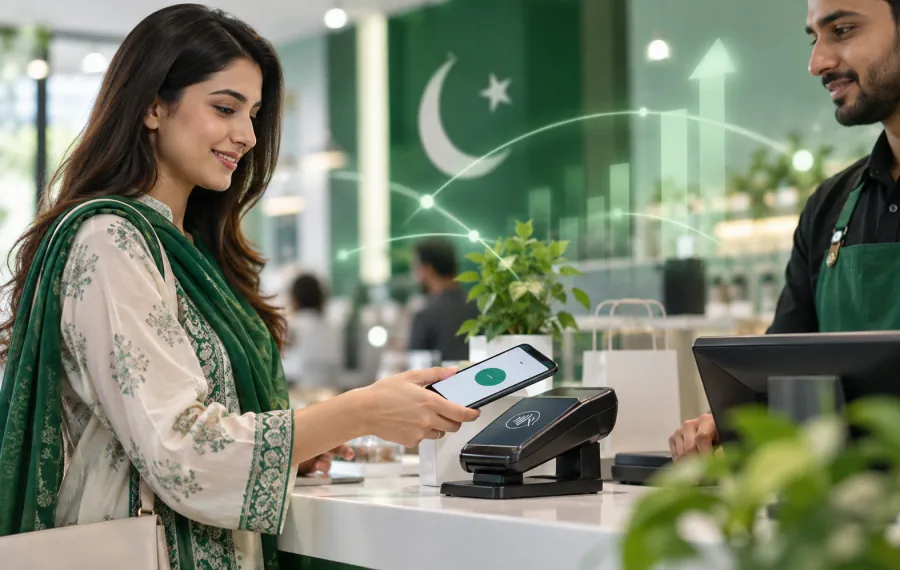
Pakistan’s shift towards a cashless economy has accelerated sharply, with the number of digital banking users reaching 137 million and electronic transactions climbing to 11.9 billion within a year.
A senior government official said Pakistan had approximately 95 million digital banking users in June 2025. The government initially aimed to raise that number to 120 million by June 2026, but the total surpassed the target by 17 million.
Also Read:
The number of digital transactions also recorded substantial growth, increasing from 6.9 billion to 11.9 billion over the same period.
The official attributed the progress to coordinated efforts involving banks, fintech companies, federal departments and provincial governments under the Cashless Pakistan initiative.
Digital payments across government entities have also expanded significantly. In categories where only 9% and 5% of payments were digitised in June 2025, the respective shares increased to 76% and 75% by June 2026.
The Cashless Pakistan programme, being led by Prime Minister Shehbaz Sharif, seeks to promote alternatives to cash, including QR-code payments, bank cards and direct digital transfers.
The government wants every citizen and business to have access to at least one digital payment option when paying public institutions. The facility would cover transactions involving utility bills, toll plazas, district courts and provincial and federal departments.
Officials clarified that cash payments would not be prohibited. The objective is to ensure that people can choose a convenient digital method whenever they need to make a payment to the government.
The immediate priority is to expand the use of Raast, Pakistan’s local instant-payment system. The platform enables free and immediate transfers and is already available through several banking applications.
The government is also aware of growing public demand for international services such as Google Wallet and Apple Wallet. However, its current focus remains on strengthening local payment infrastructure and encouraging wider adoption of Raast.
Authorities believe greater use of digital payments will make everyday transactions more convenient, reduce dependence on cash and improve transparency across the economy.
The expansion could also help document commercial activity and broaden Pakistan’s tax base, although officials acknowledge that a considerable trust deficit continues to exist between businesses and the Federal Board of Revenue.
To address traders’ concerns, the government has introduced a simplified fixed-tax scheme for shopkeepers following consultations with the business community.
Under the scheme, shopkeepers can declare the required information through a simple form and pay a final tax. Once the payment has been made, the FBR will not reopen their tax matters for that financial year.
The government maintains that the fixed-tax scheme and Cashless Pakistan programme serve different purposes. The tax scheme simplifies compliance, while the cashless initiative is intended to provide consumers and businesses with faster, safer and more convenient payment options.