Global Oil Prices Surge As US-Iran Tensions Escalate And Middle East Risks Grow
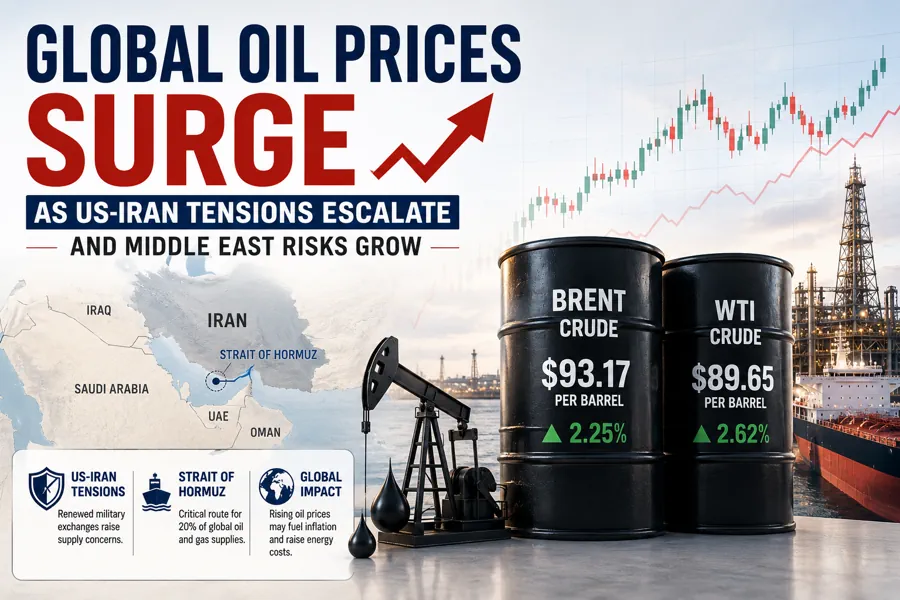
- Brent crude climbed above $93 a barrel while US crude approached $90 after fresh military exchanges between the US and Iran.
- Concerns over the Strait of Hormuz and broader Middle East tensions have intensified fears of supply disruptions.
- Rising oil prices could add to global inflation pressures and increase energy costs for oil-importing countries.
Global oil prices surged by more than 2 percent on Monday after renewed military exchanges between the United States and Iran heightened concerns about energy supplies from the Middle East, one of the world’s most important oil-producing regions.
Brent crude futures rose by $2.05, or 2.25 percent, to $93.17 per barrel, while US West Texas Intermediate (WTI) crude gained $2.29, or 2.62 percent, to reach $89.65 per barrel during early trading.
Also Read:
The sharp increase came after the United States and Iran exchanged strikes over the weekend, raising fears that tensions in the region could escalate further and disrupt global oil supplies.
The latest developments also reduced expectations that Washington and Tehran would soon announce an extension of their ceasefire arrangement. Optimism surrounding a possible extension had helped push oil prices lower at the end of last week, with both Brent and WTI settling nearly 2 percent down on Friday.
According to US officials, American forces carried out what were described as “self-defence strikes” targeting Iranian radar and drone-control facilities in Goruk and Qeshm Island. Washington said the operation was conducted in response to what it called aggressive actions by Tehran.
Iran’s Islamic Revolutionary Guard Corps later stated that its aerospace force targeted an air base allegedly used in a US attack on a telecommunications facility located on Sirik Island.
The renewed military activity comes shortly after the United States hosted Israel-Lebanon peace talks in Washington. Efforts have been underway to extend a ceasefire agreement announced earlier this year and create conditions for a broader diplomatic settlement.
US President Donald Trump said on Friday that a decision on a proposed extension of the ceasefire with Iran would be made soon, giving negotiators additional time to seek a permanent solution to tensions surrounding Iran’s nuclear programme and regional security issues.
Any long-term agreement is expected to involve Israel as a key stakeholder. Iran has repeatedly insisted that Hezbollah must also be included in any broader settlement framework.
The United States has reportedly proposed a gradual de-escalation plan under which Hezbollah would halt attacks on Israel in exchange for Israeli restraint in Beirut and other sensitive areas.
Energy markets are also closely watching developments in the Strait of Hormuz, a critical shipping route through which roughly one-fifth of the world’s oil and natural gas supplies pass.
Analysts warn that concerns over mines in the waterway and potential disruptions to maritime traffic continue to pose significant risks to global energy markets. Reports suggest that Iran recently deployed additional mines in the area, adding to fears that shipping activity could remain restricted even if diplomatic progress is achieved.
The effective closure of the Strait of Hormuz since the conflict began has increased concerns over future oil availability and contributed to the latest price rally.
Market analysts note that even if a political agreement is eventually reached, a rapid increase in oil supply is unlikely. Any reopening of key shipping routes could take time, limiting immediate relief for global energy markets.
The supply concerns outweighed weaker economic data from China, which showed slowing factory activity and continued pressure on exports. Under normal circumstances, weaker demand from the world’s second-largest economy would weigh on oil prices, but geopolitical risks have remained the dominant factor for traders.
Meanwhile, investment bank Goldman Sachs warned that weak oil demand from China and Europe could create downside risks for prices later this year. However, the bank also noted that any prolonged disruption to Middle East energy supplies could continue to push oil prices higher despite softer global demand.
With tensions between the United States, Iran, Israel and regional groups remaining elevated, investors are expected to closely monitor developments in the Middle East, as further escalation could have major implications for global energy markets, inflation and economic growth.