Budget 2026-27: No New Taxes On Solar Panels, Fertilisers As Govt Finalises Proposals
- The government has decided not to impose new taxes on solar panels and fertilisers in Budget 2026-27.
- Provinces are expected to receive around Rs8.2 trillion under the NFC Award next fiscal year.
- Officials say Pakistan’s economic indicators have improved, with reserves and remittances showing growth.
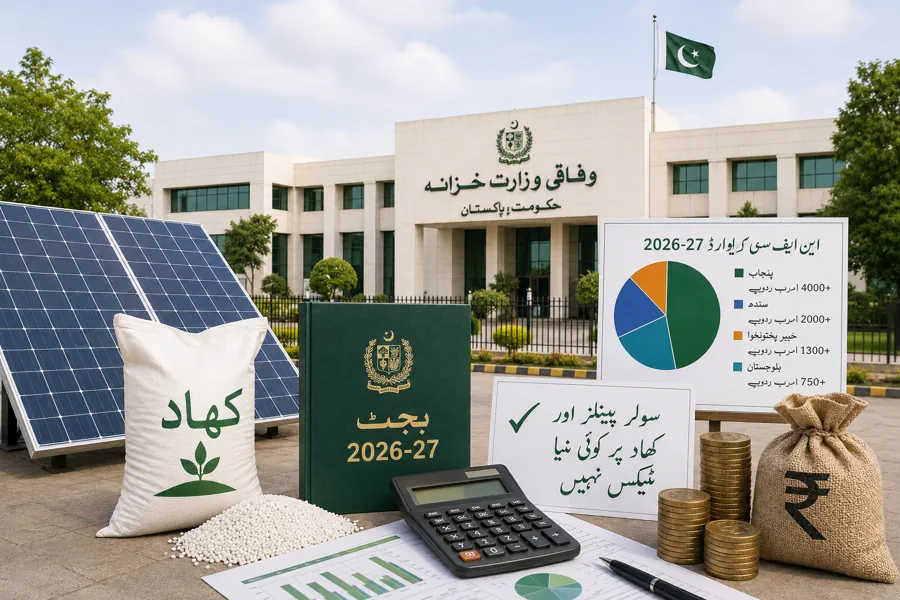
The federal government has decided against imposing new taxes on solar panels and fertilisers in the upcoming Budget 2026-27, providing relief to consumers, farmers and the renewable energy sector as budget preparations enter their final stage.
According to sources, authorities have made a final decision to keep existing tax rates on solar panels and fertilisers unchanged for the next fiscal year. The move is expected to support agricultural production and encourage the continued adoption of solar energy across the country.
Also Read:
While ruling out new taxes on these sectors, the government is considering adjustments to income tax rates on certain imported products. Sources said income tax on the import of some items may be increased from 1 percent to 2 percent, while rates on other products could rise from 2.5 percent to 5.5 percent.
The budget proposals also include significant financial transfers to provinces under the National Finance Commission (NFC) Award. An estimated Rs8.2 trillion is expected to be distributed among the provinces during the next fiscal year.
Punjab is projected to receive more than Rs4 trillion under the NFC Award, making it the largest recipient. Sindh is expected to receive over Rs2 trillion, while Khyber Pakhtunkhwa could receive more than Rs1.3 trillion. Balochistan’s share is estimated at around Rs750 billion.
The latest developments were discussed during a meeting of the National Assembly Standing Committee on Finance held in Islamabad under the chairmanship of senior PPP leader and Member of National Assembly Syed Naveed Qamar.
During the meeting, Naveed Qamar confirmed that the federal budget for fiscal year 2026-27 will be presented in the National Assembly on June 5, 2026.
He said economic experts would brief committee members on key aspects of the upcoming budget and the country’s economic outlook.
Addressing the meeting, economist Ali Salman said Pakistan’s economy has shown signs of stability in recent months. He noted that the country’s foreign exchange reserves have crossed $22 billion, while the State Bank of Pakistan’s reserves stand at approximately $17 billion.
He also highlighted the growth in overseas remittances, stating that Pakistan received around $33 billion in remittances, providing important support to the economy and external account.
Ali Salman said Pakistan’s current account deficit currently stands at $324 million. However, he noted that inflation remains in double digits despite improvements in several macroeconomic indicators.
He further stated that government borrowing has declined, reflecting efforts to improve fiscal management and reduce economic pressures.
During the discussion, Javed Hanif pointed to recent reductions in interest rates as a key source of relief for businesses and consumers, saying the policy had helped improve economic conditions.
The government’s decision to avoid additional taxation on solar panels and fertilisers is likely to be welcomed by both the agricultural sector and renewable energy stakeholders, as policymakers seek to balance revenue generation with economic growth and public relief measures in Budget 2026-27.