Trump Says US Could Declare Strait of Hormuz its Territory as Iran Rejects Assertion
- Trump says the US could soon declare the Strait of Hormuz its territory after claiming Washington has control of the strategic waterway.
- Iran rejects the claim, insisting the strait remains under Iranian control and vessels cannot pass without Tehran’s permission.
- Disruption around Hormuz has pushed Brent crude close to $90 a barrel and US gasoline prices to around $4 a gallon.
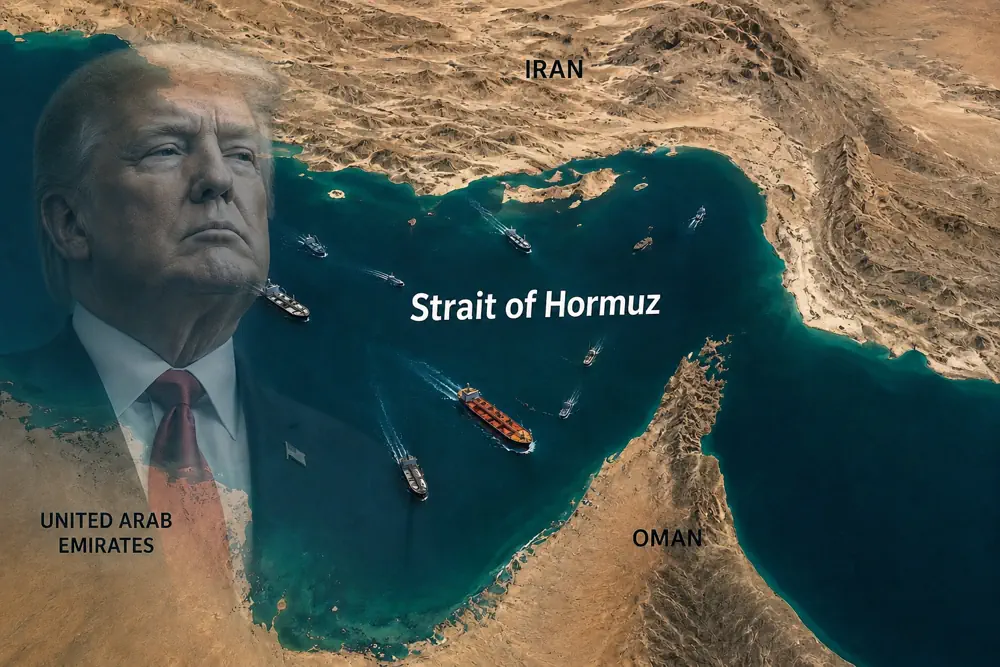
US President Donald Trump has said the United States could soon declare the Strait of Hormuz its territory, drawing a sharp response from Iran as the conflict and disruption around the strategic waterway continue to put pressure on global oil markets and fuel prices.
Speaking in Garden City on Friday, Trump said that after the United States finished what he described as defeating Iran, he would “pretty soon” declare the Strait of Hormuz a territory of the United States. It was not immediately clear whether the statement represented a formal shift in US policy or was part of the president’s increasingly forceful rhetoric over the waterway.
Also Read:
Trump has also claimed that the US Navy is enforcing a complete blockade of the Strait of Hormuz and said on Truth Social that Washington has “full control” of the strait and believes it can maintain that control.
Iran strongly rejected those assertions, with Deputy Foreign Minister Kazem Gharibabadi saying the strategic passage could not be taken through political declarations or military force.
“The Strait of Hormuz cannot be seized by a tweet, an aircraft carrier, an order, or an election speech,” Gharibabadi said in a post on X.
The Iranian official accused Washington of refusing to recognise what he described as its strategic setbacks against Tehran. He said Iran would not be intimidated by threats or displays of military power and insisted that the Strait of Hormuz “was Iran’s, is Iran’s, and will remain Iran’s.”
Gharibabadi further claimed that the waterway would be opened or closed only on Iran’s orders. He said Tehran intended to continue its blockade until Washington accepted what Iran considers the reality of its defeat and abandoned its current position.
Ibrahim Zolfaqari, spokesperson for Iran’s Khatam Al Anbiya Central Headquarters, also rejected Trump’s assertion that the United States controlled the strait. He said no vessel would be allowed to pass through Hormuz without Iranian permission and supervision.
Iranian officials have maintained that the waterway will remain closed while the United States continues its intervention, maintains a naval blockade and does not meet what Tehran says are the requirements of a June framework agreement between the two countries.
The escalating dispute has major implications for global energy markets because roughly 20% of the world’s oil and liquefied natural gas shipments normally pass through the Strait of Hormuz. Concerns over prolonged disruption have contributed to higher oil prices, with Brent crude approaching $90 a barrel this week.
American motorists are also facing higher costs, with US gasoline prices rising to around $4 a gallon. Trump has urged Americans to accept some increase in fuel prices, arguing that it is part of the cost of preventing Iran from acquiring a nuclear weapon.
During his speech, Trump said Americans who have to “pay a tiny little bit more” for gasoline should consider the broader objective of stopping Iran from developing nuclear weapons. He described US actions as a service not only to the United States but to the wider world and said he would not apologise for attacking Iran.
The rise in energy costs, however, could create political difficulties for Trump because lower fuel and energy prices have been among his key economic promises. Democrats are seeking to focus attention on the economic consequences of the Iran conflict ahead of the US midterm elections in November.
The conflict is also placing sustained pressure on US military personnel. Trump separately dismissed concerns over the unusually long deployment of the USS Abraham Lincoln, which has been supporting US military operations related to the war with Iran.
Asked by reporters before travelling to New York whether the aircraft carrier’s deployment of more than 260 days had gone on too long, Trump replied that it was “not nearly long enough.” He said the carrier was moving or would move shortly and would be replaced by another similar ship.
The USS Abraham Lincoln departed its home port of San Diego last November before being redirected to the Middle East. Around 5,000 sailors and Marines are aboard the carrier.
According to Democratic Senator Richard Blumenthal, a member of the Senate Armed Services Committee, the ship has gone more than 200 days without a port call, setting a modern-day record for consecutive days at sea.
Several Democratic lawmakers have sought answers after families of sailors raised concerns about mental health, living conditions and supply problems aboard the carrier. US Defence Secretary Pete Hegseth rejected reports about deteriorating conditions on Thursday, saying the situation aboard the USS Abraham Lincoln had been “completely misrepresented.”