Sindh Presents Rs3.56 Trillion Budget for FY2026-27, Announces 7pc Salary Increase and No New Taxes
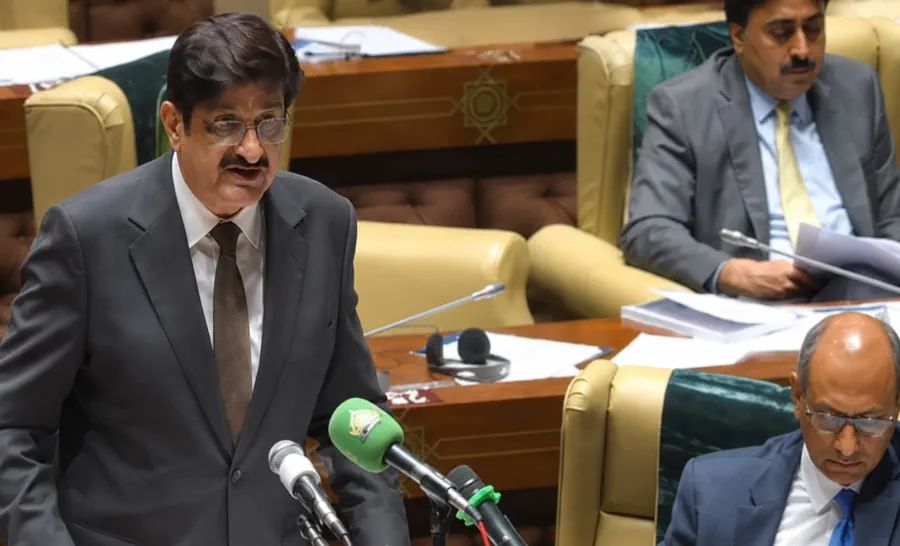
Sindh Chief Minister Syed Murad Ali Shah on Wednesday unveiled a Rs3.56 trillion provincial budget for the fiscal year 2026-27, featuring no new taxes, a 7 per cent increase in salaries and pensions for government employees, and a Rs400 billion development programme aimed at supporting economic growth and public welfare.
Presenting the budget in the Sindh Assembly, CM Shah said the government expects total receipts of Rs3.41 trillion, while the budget carries an estimated deficit of around Rs242 billion. The budget session took place amid a boycott by opposition members.
Also Read:
The chief minister announced that ad hoc relief allowances introduced in 2022 and 2025 would be incorporated into employees’ basic salaries. He also revealed that the minimum monthly wage would be raised to Rs43,000, describing the budget as a balanced plan focused on providing relief to citizens and businesses while maintaining fiscal discipline.
According to CM Shah, the budget has been formulated around four core principles: protection of constitutional rights, fiscal sustainability, national stability and public welfare.
During the assembly proceedings, lawmakers belonging to the Muttahida Qaumi Movement-Pakistan (MQM-P) staged a protest and walked out before the budget speech. Opposition Leader Ali Khurshidi said the party was boycotting the session due to a lack of consultation and argued that the budget failed to adequately address the concerns of urban Sindh.
Despite the opposition’s absence, the chief minister continued with the presentation, noting that it marked the 13th provincial budget he has presented and the 11th consecutive budget during his tenure.
Reviewing the outgoing fiscal year, CM Shah said the provincial government had spent more than Rs900 billion on development projects. He stated that 952 development schemes were completed, including 337 road projects, 179 local government initiatives and 175 water supply and drainage schemes.
A major announcement in the budget is the establishment of the Sindh International Financial Centre in Karachi. The facility is expected to promote infrastructure financing, Islamic banking and climate finance while attracting investment in advanced data centres, artificial intelligence infrastructure and environmentally friendly digital technologies.
The chief minister also unveiled plans to develop Keti Bandar into a major maritime, industrial, logistics and energy hub. Linked with the Dhabeji Special Economic Zone and Thar, the project aims to strengthen Pakistan’s connection to international trade routes and create a new gateway for economic activity.
Renewable energy has been given significant attention in the budget. CM Shah announced Sindh’s largest solar energy initiative, which includes the distribution of 275,000 free solar home systems and the introduction of a subsidised solar financing programme for households and businesses.
In the social welfare sector, the government has allocated Rs13.2 billion for a social protection package. The programme includes kitchen garden schemes, the Benazir Hari Card, the Benazir Women Agriculture Workers Programme, and continued support for widows and orphans.
The chief minister also announced relief measures for the education, agriculture, insurance and employment sectors. Sales tax on educational support services has been reduced to 5 per cent, while existing concessional tax rates for beauty salons and overseas employment recruiting agencies will remain unchanged.
Highlighting achievements in public welfare, CM Shah said one million homes had been completed for flood-affected families under the Sindh Peoples Housing Programme. He added that the government had expanded the 1122 ambulance network, improved telemedicine services, built more than 1,300 school buildings and recruited additional teachers.
He further stated that Sindh had agreed to contribute Rs260 billion towards national stability measures and had successfully protected the province’s interests during discussions on the National Finance Commission (NFC) Award.
Due to fiscal pressures, the development budget has been reduced from Rs575 billion in the current fiscal year to Rs400 billion for FY2026-27. However, the government plans to continue investing in infrastructure, industry, trade and job creation projects.
Among the major infrastructure achievements highlighted by the chief minister was the Rs60.7 billion Shahrah-e-Bhutto project in Karachi. He said the project has significantly improved connectivity, reduced travel times to nearly 25 minutes and is currently serving approximately 25,000 vehicles every day.
Concluding his speech, CM Shah said the budget is designed to lay the groundwork for a modern and competitive economy powered by investment, technology, renewable energy and inclusive development.