Pakistan’s Pharma Exports Hit 20-Year High at $457m as Govt Eyes Global Hub Status
- Pharmaceutical exports surged 34% to a 20-year high of $457 million in FY2025.
- The sector generated Rs523 billion in revenue and currently has 662 manufacturers operating across Pakistan.
- Pakistan is targeting WHO Level 3 status by April 2027, which could expand access to more than 150 international markets.
- The government and industry will develop a roadmap aimed at eventually increasing pharmaceutical exports to $10 billion.
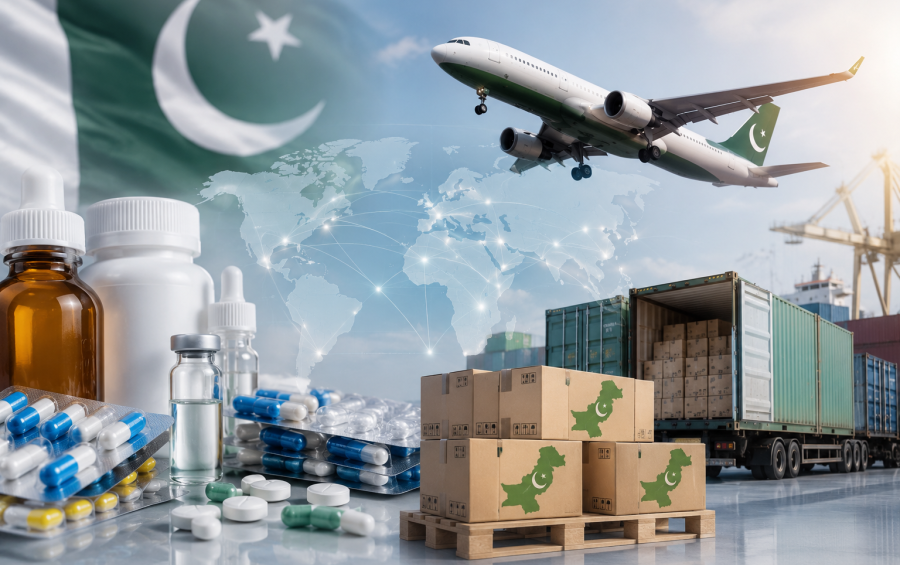
Pakistan’s pharmaceutical exports have climbed to a 20-year high of $457 million in FY2025, recording annual growth of 34% and providing fresh momentum to the government’s plan to transform the country into a competitive global pharmaceutical hub.
Federal Minister for Planning Ahsan Iqbal said Pakistan must use the export milestone as a starting point for a much larger expansion of the industry, with greater emphasis on innovation, international quality standards, research, local production and access to regulated global markets.
Also Read:
The minister made the remarks while chairing a pharmaceutical roundtable in Islamabad on Friday, attended by industry experts and key stakeholders. Adviser to the Prime Minister on Industries and Production Haroon Akhtar Khan and Federal Health Minister Mustafa Kamal were also present.
Ahsan Iqbal said the roundtable was designed to go beyond conventional consultations by bringing the government, pharmaceutical companies, universities and research institutions onto a common platform to develop practical solutions for the sector’s long-term growth.
According to figures presented at the meeting, Pakistan’s pharmaceutical industry generated Rs523 billion in revenue during FY2025, an increase of 19.4%, while exports reached $457 million. The country currently has 662 pharmaceutical manufacturers in operation.
The sector’s proposed growth roadmap seeks to move exports from the current $457 million level towards a $2 billion target. It then envisages reaching $3 billion through PharmEx within three years and eventually $10 billion within eight years.
Ahsan Iqbal said Pakistan needed to move beyond incremental export gains if it wanted to achieve its broader national ambition of more than $100 billion in exports by 2035. The real challenge, he said, was whether Pakistan could establish itself as a global pharmaceutical hub over the next decade.
He stressed the need to strengthen missing links in both domestic and international value chains and build confidence in Pakistani medicines abroad. The objective should be to make “Made in Pakistan” a recognised mark of quality and reliability in international pharmaceutical markets.
International regulatory compliance was identified as one of the most important areas for future expansion. Pakistan currently has access to 52 WHO Level 2 markets and is targeting WHO Level 3 status by April 2027, a development that could potentially provide access to more than 150 markets.
Eight Pakistani pharmaceutical companies already hold approvals from international regulatory frameworks or agencies including WHO, PIC/S and the UK’s MHRA. Another 10 to 15 companies are expected to obtain international approvals by 2028.
Industry representatives were asked to identify regulatory gaps preventing more Pakistani companies and products from entering sophisticated and highly regulated markets. Heavy concentration of pharmaceutical exports in a limited number of destinations was also highlighted as a challenge requiring greater market diversification.
Reducing dependence on imported pharmaceutical ingredients emerged as another major priority. Around 85% of Pakistan’s active pharmaceutical ingredients (APIs) are imported, with China accounting for approximately 85% to 90% of those supplies. The government wants greater domestic capacity to reduce this dependence and strengthen the resilience of the pharmaceutical value chain.
Ahsan Iqbal also called for stronger links between pharmaceutical companies, universities, pharmacy departments and research institutions. He said Pakistan had invested billions of rupees in higher education, laboratories and human-resource development, but these resources needed to be more closely connected with the requirements of industry.
Research laboratories, he said, should not exist merely to produce academic work but should generate knowledge, technologies and solutions capable of contributing directly to Pakistan’s economic and industrial development. Better integration of the country’s scientific, technological and human capabilities with industry could deliver substantial economic gains.
Regulatory reform was another key focus of the discussion. The planning minister said regulation must maintain quality and compliance standards without becoming an unnecessary obstacle to investment, innovation or expansion.
Industry stakeholders were therefore asked to identify regulatory and administrative barriers restricting growth so that the government could work towards removing them and provide pharmaceutical exporters with what the minister described as a “clean runway” to compete internationally.
As a next step, Ahsan Iqbal proposed a one-month consultation within the pharmaceutical industry involving all relevant stakeholders. The exercise will identify key priorities, challenges and growth opportunities and form the basis of a medium- and long-term roadmap extending to 2030 and beyond.
The roadmap will be developed in consultation with the Ministry of Planning and is expected to specify the policies, reforms and government support required to sustain the industry’s expansion.
The government says its role will be to facilitate private-sector growth, improve the business environment and ensure policy continuity, while the industry focuses on investment, innovation, quality and international competitiveness.
The broader strategy is aimed at building on the record $457 million export performance by removing regulatory and value-chain bottlenecks, strengthening research and innovation, diversifying export destinations, localising production and positioning Pakistan’s pharmaceutical industry as a significant contributor to the country’s $100 billion-plus export ambition by 2035.