Allama Muhammad Iqbal
Allama Muhammad Iqbal (1877–1938), Pakistan’s national poet, was a philosopher and barrister whose Urdu and Persian poetry, philosophy of selfhood (khudi), and 1930 Allahabad Address helped shape the intellectual foundations of Pakistan.
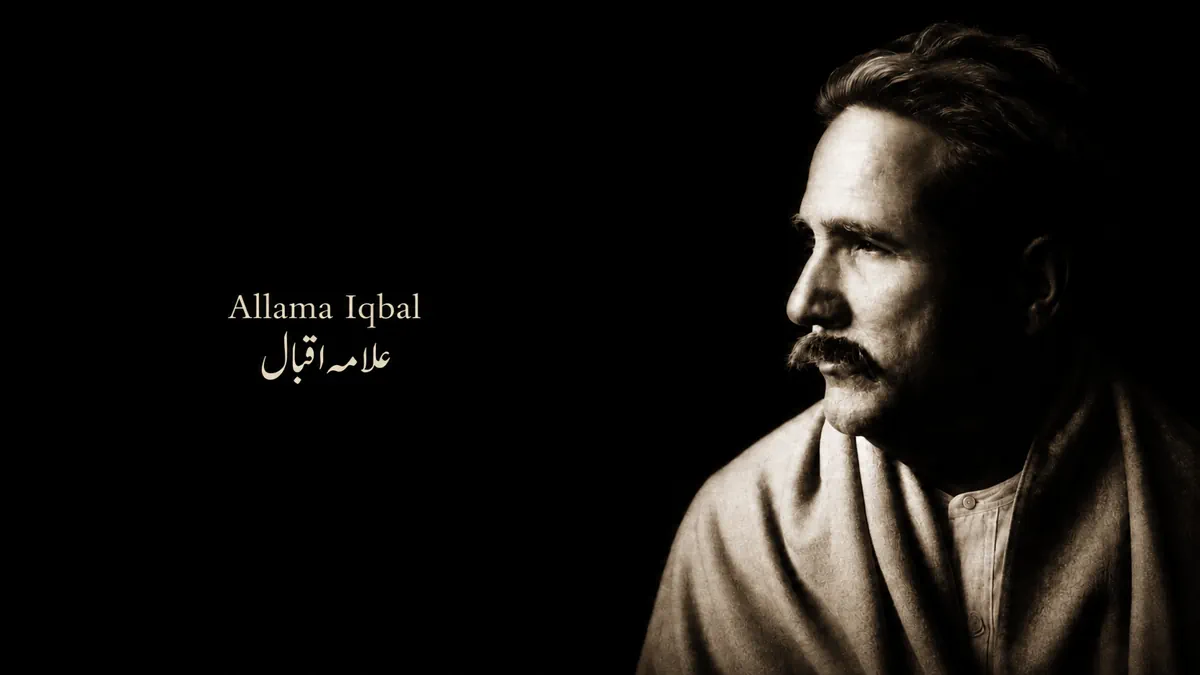
Sir Muhammad Iqbal (Urdu: محمد اقبال), widely known as Allama Iqbal, was a poet, philosopher, barrister and political thinker in British India. Born in Sialkot on 9 November 1877, he became a major figure in Urdu and Persian literature and developed a philosophy of khudi, or selfhood, that linked personal growth with moral responsibility. His 1930 Allahabad Address proposed grouping Muslim-majority territories in northwestern India into a self-governing political unit. The speech and his later correspondence with Muhammad Ali Jinnah helped shape the intellectual case for Pakistan, where he is remembered as the national poet. Iqbal died in Lahore on 21 April 1938, nine years before Pakistan was established.
| Full name | Sir Muhammad Iqbal |
| Urdu name | محمد اقبال |
| Commonly known as | Allama Iqbal |
| Honorifics | Allama, Shair-e-Mashriq (Poet of the East), Mufakkir-e-Pakistan (Thinker of Pakistan) |
| Born | 9 November 1877 |
| Birthplace | Sialkot, Punjab, British India, now in Punjab, Pakistan |
| Died | 21 April 1938, aged 60 |
| Place of death | Lahore, Punjab, British India, now in Punjab, Pakistan |
| Resting place | Tomb of Allama Iqbal, beside the Badshahi Mosque, Lahore |
| Parents | Sheikh Noor Muhammad and Imam Bibi |
| Spouses | Karim Bibi, Sardar Begum and Mukhtar Begum |
| Children | Aftab Iqbal, Miraj Begum, Javid Iqbal and Munira Bano. An infant son born to Mukhtar Begum also died. |
| Occupations | Poet, philosopher, barrister, teacher and politician |
| Education | Scotch Mission College, Sialkot. Government College, Lahore. Trinity College, Cambridge. Doctorate from the University of Munich. Legal training at Lincoln’s Inn. |
| Writing languages | Urdu and Persian for poetry. English and Urdu for prose, with English used in several major philosophical and political writings. |
| Political roles | Punjab Legislative Council member, president of the All-India Muslim League’s 1930 Allahabad session, and delegate to the second and third Round Table Conferences |
| Principal philosophical idea | Khudi, or the cultivation of selfhood |
| Major works | Asrar-e-Khudi, Rumuz-e-Bekhudi, Payam-e-Mashriq, Bang-e-Dara, Javid Nama, Bal-e-Jibril, Zarb-e-Kalim and The Reconstruction of Religious Thought in Islam |
| Knighthood | Announced in the 1923 New Year Honours |
| Commemoration | Iqbal Day is observed on 9 November in Pakistan |
Iqbal was born into a Muslim family of Kashmiri ancestry. His father, Sheikh Noor Muhammad, worked as a tailor, and his mother, Imam Bibi, came from Sialkot. Iqbal received early instruction in the Quran and studied Arabic and Persian under Syed Mir Hasan, a scholar who encouraged his literary interests. He attended the Scotch Mission College in Sialkot before moving to Lahore in 1895 to study at Government College. Some older biographies give 1873 as his birth year. The Iqbal Academy Pakistan and the Oxford Dictionary of National Biography use 9 November 1877.
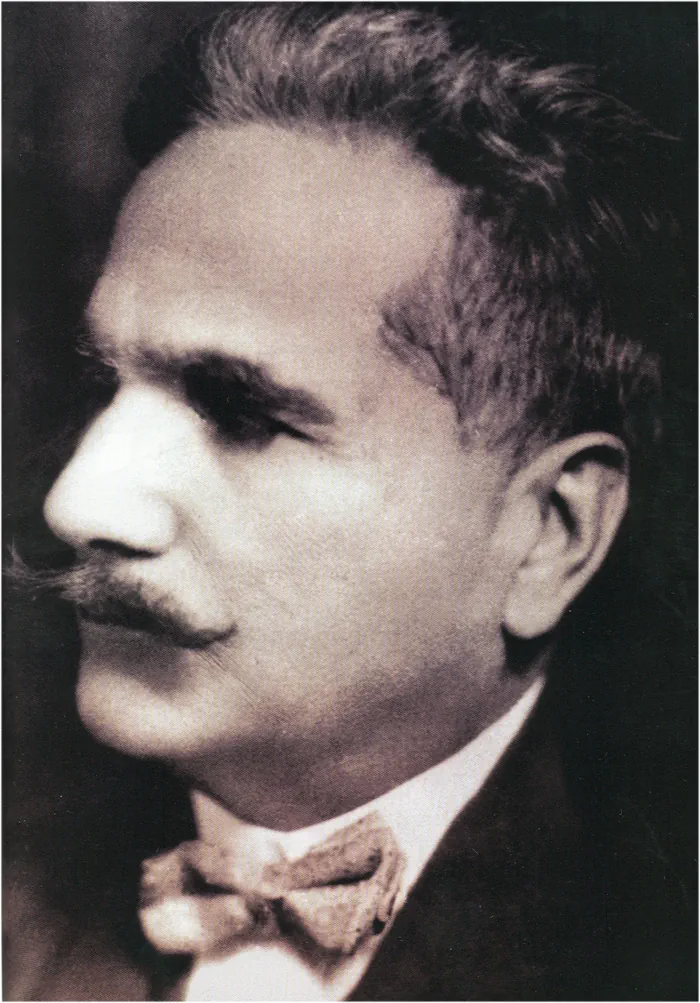
At Government College, Iqbal studied philosophy, English literature and Arabic. He completed his BA in 1897 and his MA in philosophy in 1899. One of his teachers, the British scholar Thomas Walker Arnold, introduced him to European philosophical scholarship and encouraged him to continue his studies abroad. Iqbal taught at Oriental College and Government College in Lahore. In 1903 he published Ilm-ul-Iqtisad, an Urdu work on economics that preceded the poetry collections and English philosophical books for which he became better known.
Lahore also gave Iqbal an audience for his early Urdu poetry. He recited at gatherings of Anjuman Himayat-e-Islam, a Muslim educational and charitable association, and published in the literary journal Makhzan. His early verse included poems about childhood, nature and attachment to India. The patriotic poem Tarana-e-Hindi, widely known by its opening words Sare Jahan Se Achha, dates from this period. The later Tarana-e-Milli addressed a Muslim community that extended across national borders. Together, the poems show how the communities Iqbal addressed changed over the course of his career.
Iqbal went to Europe in 1905 and studied philosophy at Trinity College, Cambridge, where he encountered the work of James Ward and John McTaggart. He pursued legal training at Lincoln’s Inn in London and spent part of 1907 in Heidelberg studying German. His doctoral research at the University of Munich examined religious and philosophical traditions in Persia. The dissertation, The Development of Metaphysics in Persia, was published in London in 1908. He was called to the bar at Lincoln’s Inn that year and returned to Lahore, where legal practice became his principal livelihood alongside writing, teaching and public affairs.
Iqbal’s family life included three marriages. He and Karim Bibi had a daughter, Miraj Begum, and a son, Aftab Iqbal, who became a barrister. Mukhtar Begum and her infant son died around the time of childbirth in 1924. Iqbal and Sardar Begum had a son, Javid Iqbal, and a daughter, Munira Bano. Javid became a judge and wrote about his father’s life. Biographical accounts differ on the dating and sequence of some of Iqbal’s marriages. His poem Walida Marhuma Ki Yaad Mein, collected in Bang-e-Dara, commemorates his mother, who died in 1914.
After returning from Europe, Iqbal developed a poetic voice that combined religious reflection with criticism of Muslim political and social life. In Shikwa (The Complaint), a collective speaker asks why Muslims have lost power and standing despite their devotion and historical achievements. Jawab-e-Shikwa (The Answer to the Complaint) replies in a divine voice, directing attention to the community’s own conduct. The two poems became among his most widely recognized Urdu works and were later collected in Bang-e-Dara.
Iqbal published Asrar-e-Khudi (The Secrets of the Self) in Persian in 1915. The poem presents the self as something a person develops through discipline, love, creative effort and action. The companion work Rumuz-e-Bekhudi (The Mysteries of Selflessness) turns to the obligations of individuals within a community. Read together, the two works connect the development of individual character with participation in a shared moral and social life. Reynold A. Nicholson’s 1920 English translation of Asrar-e-Khudi introduced the poem to a wider readership.
Persian gave Iqbal access to a literary tradition that reached well beyond South Asia. In Payam-e-Mashriq (Message of the East, 1923), he responded to Johann Wolfgang von Goethe’s West–Eastern Divan and addressed questions of culture, power and renewal through Persian verse. Zabur-e-Ajam (Persian Psalms, 1927) included Gulshan-e-Raz-e-Jadid, a response to the medieval Persian poet Mahmud Shabistari. In Javid Nama (1932), dedicated to his son Javid, Iqbal travels through the celestial spheres with the Persian poet and mystic Jalal al-Din Rumi as his guide. Their encounters with figures from religion, philosophy and politics give the poem a structure for examining human freedom, faith and collective life.
His major Urdu collections chart a different part of the same literary career. Bang-e-Dara (The Call of the Marching Bell, 1924) brings together poems from several periods, including Lab Pe Aati Hai Dua, Khizr-e-Rah and Tulu-e-Islam. Bal-e-Jibril (Gabriel’s Wing, 1935) contains ghazals and longer poems, including Masjid-e-Qurtuba, inspired by his visit to Córdoba in Spain. Zarb-e-Kalim (The Rod of Moses, 1936) addresses subjects such as education, art, religion and political power. His final collection, Armaghan-e-Hijaz (Gift of the Hijaz), appeared posthumously in 1938 and contains both Persian and Urdu verse, including the Urdu poem Iblis Ki Majlis-e-Shura. His late Persian works also include Musafir, inspired by his travels in Afghanistan, and Pas Cheh Bayad Kard, Ay Aqwam-e-Sharq, which asks what the peoples of the East should do in response to contemporary political conditions.
The Quran was central to Iqbal’s philosophy. He also drew on Muslim thinkers such as Rumi and al-Ghazali and engaged with European thinkers including Friedrich Nietzsche and Henri Bergson. His concept of khudi emphasizes the capacity of human beings to act, make moral choices and develop their abilities in relation to God and society. Rumi was a recurring guide in this work. Iqbal valued forms of mystical experience that could deepen moral action in the world and criticized spiritual withdrawal when he saw it as encouraging passivity. In his poetry, the shaheen, or falcon, became a recurring image of independence, aspiration and courage.
Iqbal set out much of his religious philosophy in The Reconstruction of Religious Thought in Islam. The initial volume of six lectures appeared in 1930, and an expanded edition with a seventh lecture followed in 1934. The lectures examine religious experience, the nature of God, human freedom, prayer and the relationship between faith and knowledge. In his discussion of ijtihad, the exercise of independent judgment in Islamic law, Iqbal considered how representative legislatures might take part in interpreting legal principles as social conditions changed. His English prose also includes the doctoral study on Persian metaphysics, while Stray Reflections preserves notes he began writing in 1910.
Iqbal received a knighthood in the 1923 New Year Honours. Biographer Mustansir Mir records that Iqbal sought recognition for his former teacher Syed Mir Hasan when the honour was offered. Mir Hasan received the title Shams-ul-Ulama. By the late 1920s, Iqbal was a member of the Punjab Legislative Council. He served through 1930, becoming involved in debates over Muslim representation and the constitutional future of British India.
On 29 December 1930, Iqbal presided over the All-India Muslim League’s annual session at Allahabad. He proposed bringing Punjab, the North-West Frontier Province, Sind and Baluchistan into a single self-governing unit. He also discussed redrawing boundaries and excluding some non-Muslim-majority districts. The speech placed the proposal within a debate over an Indian federation and left open whether the unit would govern itself within or outside the British Empire. In a 1931 letter to The Times, Iqbal described what he had proposed at Allahabad as a Muslim province within a projected Indian federation. The address became an important precursor to the Pakistan Movement, and the constitutional arrangements and borders that emerged in 1947 took shape through later negotiations.
Iqbal attended the second and third Round Table Conferences in London in 1931 and 1932, where British officials and delegates from India debated constitutional reform. He also took part in public advocacy concerning Kashmir and attended the Islamic Congress in Jerusalem in 1931. In March 1932 he presided over the All-India Muslim Conference in Lahore. His travels brought him to France, where he met Bergson, and to Spain, where he visited the Mosque of Córdoba. In 1933 he travelled to Afghanistan at the invitation of its government to advise on higher education, a journey that informed his Persian poem Musafir.
Some of Iqbal’s later interventions concerned who could claim to represent Muslims in British India. In the mid-1930s he publicly argued that Ahmadis should be treated as a separate community for political purposes, a position contested by Ahmadis. He also debated the scholar Husain Ahmad Madani over nationalism. Madani defended the idea that people of different faiths could form a nation based on a shared homeland, while Iqbal stressed the importance of Islam as a basis for Muslim collective identity. These disputes show how questions about religion and citizenship intersected with his proposals for constitutional reform.
In letters to Muhammad Ali Jinnah between May 1936 and November 1937, Iqbal urged the Muslim League to address poverty and economic insecurity among ordinary Muslims. He argued that constitutional protections needed to be accompanied by measures that could improve people’s material conditions. In June 1937 he raised the possibility of a separate federation of Muslim-majority provinces and discussed Bengal alongside northwestern India. Jinnah later linked Iqbal’s views to the political conclusions that found expression in the Muslim League’s Lahore Resolution of 1940, adopted two years after Iqbal’s death.
Illness reduced Iqbal’s ability to practise law and travel during his final years, although he continued to write and correspond. In May 1935 he moved into Javid Manzil in Lahore, a house named for his son. Sardar Begum died that month. Iqbal spent his remaining years at the house and died there on 21 April 1938. He was buried beside Lahore’s Badshahi Mosque. Javid Manzil later became a museum, preserving manuscripts, personal belongings and other material associated with his life.
Iqbal’s legacy extends across several literary and political traditions. In Pakistan, his birthday is commemorated as Iqbal Day, and his speeches and letters are studied in the history of the Pakistan Movement. In India, Sare Jahan Se Achha remains one of his most recognizable works. In Persian-speaking circles, where he is also known as Iqbal-e-Lahori, his Persian poetry has its own readership and scholarly tradition. The Iqbal Academy Pakistan and the Iqbal Cyber Library preserve and circulate his writings, translations and research about his life. The continued readership of his verse in both Urdu and Persian reflects the range of a career that moved between poetry, philosophy, law and constitutional politics.